AIC4NL 2025 year in review video
AIC4NL in 2025: AI in action
2025 was an exciting year for AI in Europe and the Netherlands. Globally, investments in AI accelerated rapidly, with large-scale programs and capital flows in the United States and China. This once again highlighted the strategic importance of AI for economic growth, geopolitical position, and as an accelerator for societal transitions.
Europe responded with a combination of ambition and frameworks. The AI Act came into force in 2025 and established an important framework for safety, transparency, and public values. At the same time, Europe made it clear that regulation must go hand in hand with investment. Initiatives such as the AI Continent Action Plan and the recommendations from the Draghi report underscored the need to invest heavily in AI in order to remain internationally competitive.
Against this backdrop, 2025 was a year in which the AI Coalition 4 NL focused on making tough choices about investments, infrastructure, and the role of AI in the Netherlands' future earning capacity. At the same time, this dynamic underscored the urgency of not become mired in analysis and policy, but rather taking concrete action on AI.
Based on our mission—to build a strong and responsible AI position for the Netherlands—we started implementing our Agenda 2025–2027 in 2025. In this agenda, we have set out what we are working towards and how we will achieve it: increasing our reach, responding to social issues, and shaping AI-driven transitions. To give direction to our efforts, we have taken on three roles: opinion leader, program builder, and director. Based on these roles, we look back on 2025 below.
Opinion leader: guiding the AI debate
By actively taking a stance in the debate on investment, infrastructure, and public values, we brought clarity and coherence to the Dutch and European AI debate.
Setting the course: an integrated AI investment agenda
In 2025, the AI landscape shifted rapidly. Global investment in AI increased rapidly, and Europe also began to take action, with major programs and investment plans such as the EU AI Continent Action Plan and the resulting Apply AI strategy. This made it clear that the Netherlands could not afford to just talk and make plans.
Against this backdrop, we have refined our course. We took stock of the AI plans in political programsand concluded that the plans are still too fragmented. During the same period, theNational Growth Fund paid us a working visit.We discussed how the Netherlands is developing AI responsibly and applying it on a large scale in practice. We saw good examples of best practice at Cairelab (the AI expertise center of the LUMC) and the police, who won theNational AI Challenge 2025.
During 2025, it became increasingly clear that this effort can only be successful with a comprehensive AI investment agenda. In our position paper, we called on politicians and the business community to invest €5 billion in AI in order to catch up with Europe's technological leaders. Many of these recommendations are reflected in theWennink report. This report underlines the importance of AI for the future earning capacity of the Netherlands and confirms the need for large-scale investments.
In debate and in the media
To guide the AI debate, our experts participated in panels, roundtable discussions, and keynotes at conferences in the Netherlands and abroad. From theUAE–Netherlands Technology & Innovation Roundtablein The Hague to participation in theNetherlands–Luxembourg Business Forum,BEB knowledge daysorganized by the Ministry of Foreign Affairs in Eindhoven, the sold-out Data Expo, and theICT&health World Conference2025.
This visibility also translated into a strong media presence. From interviews and opinion pieces to commentary in news and background programs, AI Coalition 4 NL was regularly seen and heard in publications such as De Volkskrant, BNR,Financieel Dagblad, Nederlands Dagblad, ICT&health,NRC, and EW Magazine.
Programme developer: accelerating AI innovation
Many organizations recognize the opportunities offered by AI, but face barriers as soon as its application requires specific choices, data, or capacity. As program developers, we therefore focus on developing and implementing programs that specifically accelerate AI innovation in the Netherlands, as well as on providing the necessary foundations for this, such as infrastructure.
Innovation Labs and Learning Communities: Solving AI Issues
Well-intentioned AI initiatives are still insufficiently aligned with the daily practices of organizations. Development and application often run parallel to each other, while cooperation between companies, government, knowledge institutions, and civil society organizations is precisely what is needed to solve AI issues effectively and responsibly.
Innovation LabsandLearning Communitiesbring AI innovation closer to practice. In these partnerships, participants are given the space to experiment, share knowledge, and develop AI solutions that align with concrete work processes and societal needs.
Over the past year, four new Innovation Labs and five Learning Communities have been launched. For example, the PROSPER Innovation Lab demonstrates how AI can help make healthcare information more understandable for patients and enable secure data sharing. In the Learning Community "AI for a Learning Manufacturing Industry," parties are collaborating on AI applications that support the manufacturing industry in smarter and more sustainable production.
ELSA Labs: applying ethics and legislation
As AI plays a greater role in public decision-making and social systems, ethical, legal, and social issues are also increasing. Without focused attention on these aspects, there is a risk that AI applications will not sufficiently align with public values and existing laws and regulations. At ELSA Labs, researchers and partners from the field work together on the question of how ethics and legislation influence the development and application of AI.
In March 2025, four new ELSA Labs were launched, including the Mobility DesAIgn Lab, which investigates how advanced AI, such as prescriptive digital twins, can be used responsibly in urban mobility policy. Three concrete use cases demonstrate the social, legal, and economic implications of AI in future traffic management and sustainable mobility interventions. At the end of 2025,two morenew ELSA labs were announced: the VAMAI ELSA Lab for responsible AI in healthcare and the AI4ES lab for smarter and more sustainable energy use.
Breaking Barriers: scaling up in AI startups
Scaling up successful technology is an issue that concerns many founders. Promising AI startups encounter obstacles at the stage of transitioning from technology development to scaling up. Translating technical innovation into applicable value, collaboration on data, and access to new markets requires knowledge and support that is not available in the start-up phase.
With the newBreaking Barriers program, we offer targeted support to AI startups to help them take that step toward growth. Over a period of nine months, founders work on customized issues related to market positioning, data collaboration, and preparation for market expansion, among other things.
The first five participants in the program have started. Examples includeCuurios, which converts sensor data into useful insights, andLinksight, which uses encryption technology to enable collaboration around data. One participating startup,MantiSpectra, even made it onto Nieuwsuuras a promising Dutch AI initiative in the context of the Wennink Report.
AI adoption in SMEs
Much AI innovation remains stuck in an experimental phase, while SMEs are actually capable of putting applications into practice. Without targeted support, the step from development to application remains too big for many SME entrepreneurs.
To lower that threshold, we are implementing the MIT AI scheme. This enables us to support innovative SME entrepreneurs in the development and application of AI. By 2025, fourteen new projectswill have been launched that demonstrate how AI contributes to sectoral issues.
Within the energy and sustainability sector, projects focus on smart solutions for climate- and weather-resistant energy systems, predictive maintenance of wind turbines, and automated energy optimization for businesses. In the technical industry field, work is being done on AI applications that make production processes more efficient and sustainable, such as for undersea infrastructure. Within the agriculture and food sector, projects support cleaner, more precise agriculture, with AI-driven weed control and monitoring of pollination in greenhouses. And in the health and care sector, AI innovations are accelerating the diagnosis and development of new therapies.
Arrival of the Dutch AI factory
We have succeeded in securing an AI factory to the Netherlands. The AI factory forms a new backbone for AI development and application in the Netherlands. The total investment amount of €200 million makes this the largest investment in a public digital research and innovation facility in the Netherlands to date.
The initiative came from AIC4NL, together with consortium partners SURF, TNO, and Samenwerking Noord. We are working together on the implementation, with the aim of having the AI factory fully operational by 2027.
Orchestrator: connecting the AI ecosystem and making it work
As a director, we bring parties together and ensure that knowledge, experiences, and dilemmas surrounding AI development and application are shared and utilized. In this way, we strengthen cooperation at the regional, national, and European levels.
Moving forward together with Europe
Given the geopolitical developments, the Netherlands must align its AI efforts with European ambitions and frameworks. Only through this alignment can Europe as a whole operate in a competitive, innovative, and value-driven manner in global AI development.
Based on this directive, we work together with European partners such asADRA, where AIC4NL represents the Netherlands on the Board of Directors, and ALT-EDIC. In this way, we contribute to strengthening the European AI ecosystem, accelerating AI innovation, and developing new markets, while continuing to embed European values such as transparency, security, and human rights.
This collaboration takes concrete form through international knowledge exchange and working visits, including AI, Data, Robotics Forum in Stavanger, theFuture of Compute Innovation Mission in London, a working visit to Flanders on howAI can strengthen public services,theAIRE Club Brussels, and theAI Action Summit in Paris.
Learning and accelerating through the community
AI raises similar questions and dilemmas in a wide range of sectors, from healthcare and energy to agriculture and education. Without exchange and joint reflection, organizations continue to search for solutions to the same issues, and many initiatives get stuck in pilot projects or isolated experiments.
That is why we bring professionals together throughout the year in community meetings where knowledge, experiences, and dilemmas surrounding AI development and application are shared and translated into concrete next steps.
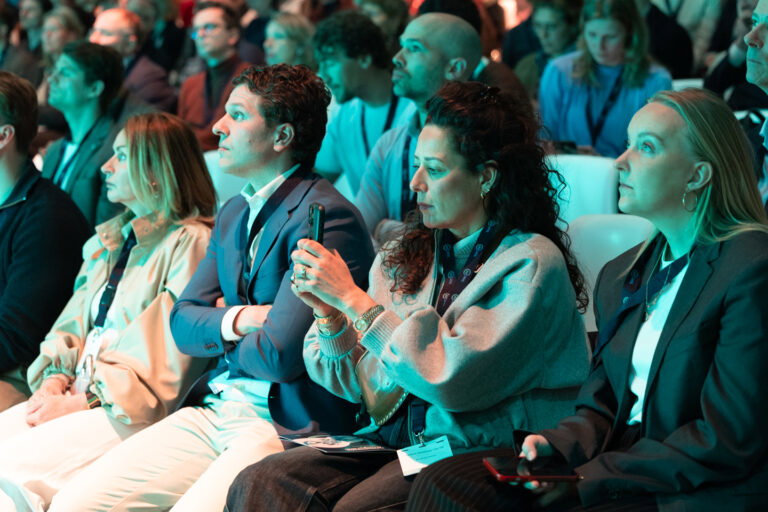
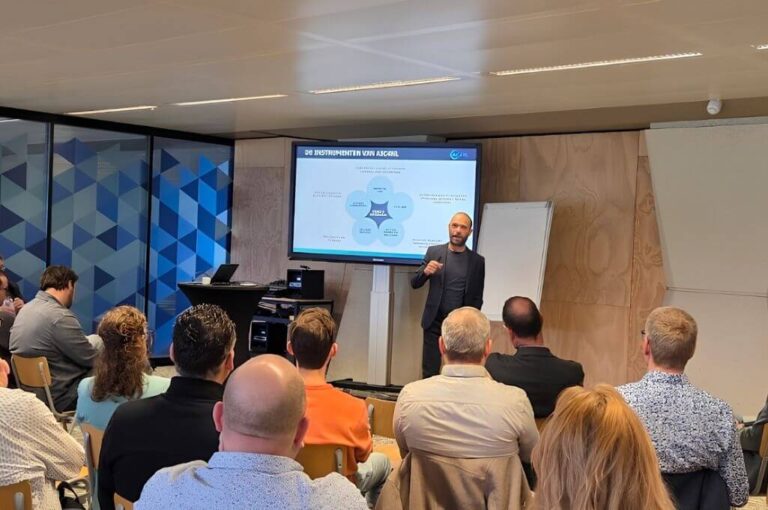
At the Dutch AI Congress, more than a thousand professionals tackled AI issues in areas such as healthcare, energy, and agriculture. We also organized numerous community events throughout the year. Participants shared their dilemmas in the field of AI development and application and worked together to find solutions. Here are a few examples:
- Launch of FARM360TECH: the European collaboration on AI in agriculture. Followed later by anational eventwith the theme: does agriculture need a national AI plan?
- National AI Debateon how we can use AI as an opportunity rather than seeing it as a threat.
- The Working Conference: From Advice to Action:AI and Future-Proof Work.
- A successfulparticipant conference on the AI Act, where it became clear that regulation is not the end, but rather the beginning of innovation.
- Health and Care Project Meeting,on how we can ensure that more pilot projects in healthcare are successful.
- A meeting about education, about how AI can strengthen education rather than hinder it.
Looking ahead to 2026
We are ending the year on an optimistic note: everything points to substantial investments in AI that will give responsible AI in the Netherlands a significant boost. AI Coalition 4 NL and our 400 participants are ready to realize these ambitions with knowledge, experience, and concrete solutions, building on what we have already achieved together in recent years.
The direction has been set and the building blocks are in place. In 2026, it will be all about impact: scaling up effective approaches, connecting new sectors, and making the transition from pilots to broader application. With the arrival of the AI factory, stronger European connections, and the continued development of our programs, we are shaping a coherent, responsible, and scalable AI transition for the Netherlands. View our plans for 2026 here.