On political views and the importance of responsible AI
AI is everywhere. In healthcare, the classroom, the factory, traffic, the courts and the military. The technology is developing rapidly and in the coming years will cause profound changes in the labor market, in public services and in our economic position in the world. The big question is not whether AI will change our society, but how we deal with it. Will the Netherlands take the lead, or will we let other countries determine? In view of the upcoming elections, this is the time for action.
AI is on the political agenda of major parties. But an integrated vision and a serious investment budget are lacking. Our election programs pale in comparison to the tens of billions that the United States and China are committing to strategic AI development. If the Netherlands and Europe do not shift gears now, we risk a technological and economic dependence that will be hard to catch up with.
Read on and find out what the major parties think about AI. The program scan is available for download at the bottom of the article.
What are the political parties saying about AI?
The AI Coalition for the Netherlands (AIC4NL) analyzed the election programs of the largest parties: VVD, GroenLinks-PvdA, D66, CDA, PVV and BBB. Our program scan shows that parties approach AI primarily from their political color. It is striking that they differ in their emphasis on investing versus regulating and in the extent to which they see AI as an opportunity or as a risk.
- Left-progressive (GreenLeft-PvdA). Emphasis on public values, ethics and oversight. GreenLeft-PvdA wants to invest in European digital infrastructure and a Civil Tech Fund, but always under strict frameworks: a ban on risky systems (such as real-time facial and emotion recognition), protection of education and culture, and rejection of mandatory data release.
- Progressive-Liberal (D66). D66 wants the Netherlands to move from consumer to producer and has ambitions to become the European leader in responsible AI. For example, D66 wants to bet on emerging technologies such as drones, space travel and cybersecurity for defense. The party encourages this through subsidies and government procurement. This investment agenda comes with firm safeguards such as human control and measures against risks to work, security and democracy. In addition, D66 advocates for a Minister of Technology, with a firm mandate and its own budget.
- Christian Democrat (CDA). Seeks balance between investment and direction. CDA seeks higher R&D spending (Lisbon 3% target) and digital autonomy through investment in European cloud, chip sector a GPT-NL as Dutch language model. This party also wants to use AI to improve processes in government and tax authorities. Central direction must be secured through an AI commissioner and anchoring of digital ethics, media literacy and cyber security.
- Right-Liberal (VVD). Sees AI primarily as an economic opportunity and is committed to substantial investment through a national technology strategy and investment agenda. In doing so, the VVD wants to accelerate licensing and mobility with AI, support SMEs in making use of applications and stimulate the digitization of government, healthcare and criminal chain. The party sees Estonia as an example of an efficient digital government, advocates room for innovation, and explicitly warns against overregulation that could inhibit economic growth.
- Critical-populist (PVV and BBB). BBB wants acceleration of innovative products through shorter approval procedures. In addition, the party sees a clear role for a National Investment Bank with venture capital for deep tech, agrotech and energy technology, among others. The party invests in a Dutch AI network through defense and argues that AI applications should be transparent, under human supervision and risks should be limited.
PVV sees AI primarily as a tool in healthcare, especially to reduce bureaucracy and administrative pressure. Has not developed a broad investment or regulatory agenda.
Broad support for an AI factory
We note that several parties explicitly include the arrival of a Dutch AI factory in their program. VVD goes the furthest and advocates not only an AI factory in Groningen, but also an AI Gigafactory to catch up strategically. GroenLinks-PvdA sees the AI factory as a place where start-ups and governments can experiment responsibly. The CDA links the factory to European digital autonomy and strengthening the knowledge infrastructure, while the BBB places the factory primarily in the context of defense and regional hubs. This makes the AI factory one of the few AI topics for which there seems to be broad political support as an investment in the future, although each party places its own emphases.
AI agenda at a glance
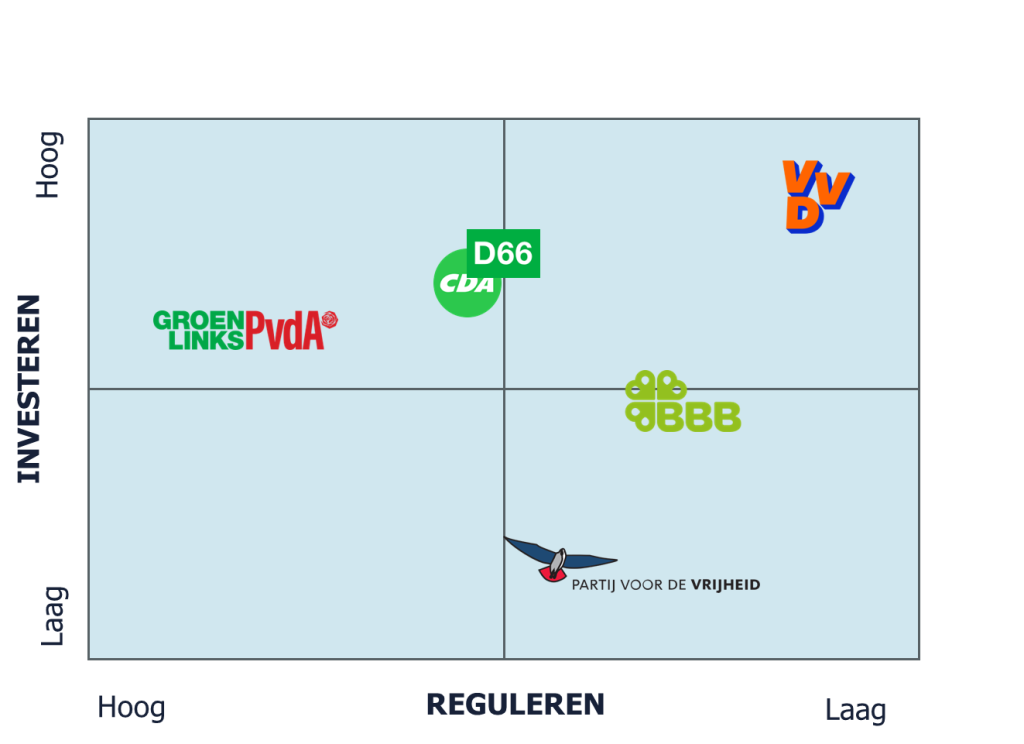
In the figure below, the parties are positioned along two axes: investing and regulating. This gives an overview of how they relate to each other in the field of AI.
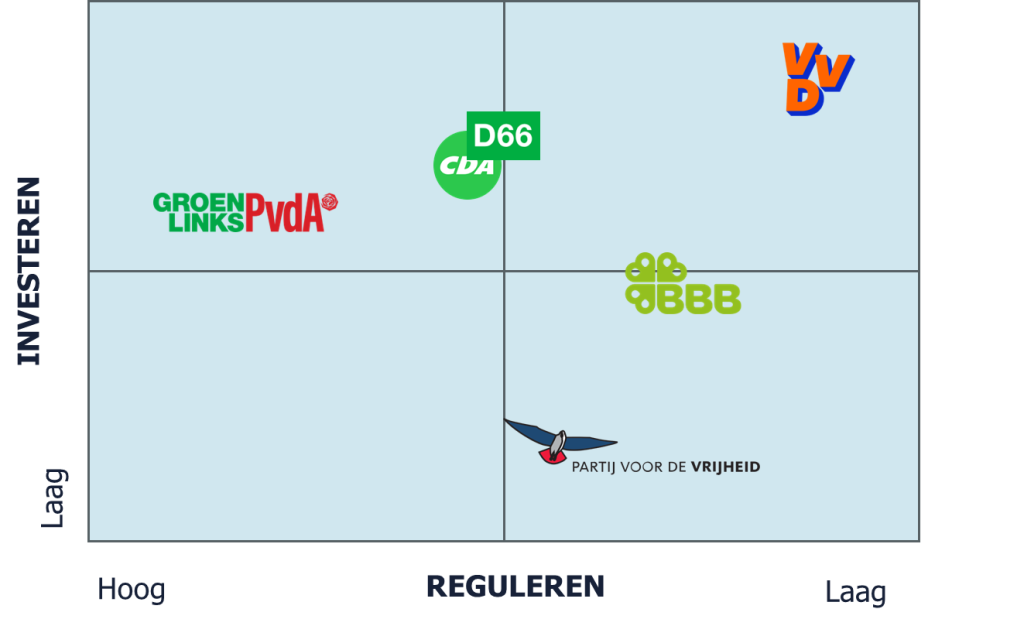
Figure: Visualization AI positions of political parties: Invest versus Regulate
Argument for plotting, see Footnote
Resumen
What emerges from this program scan is that almost all parties mention AI, but always from a different angle: sometimes as an innovation tool, sometimes as an ethical issue or geopolitical challenge. In doing so, they differ in the emphasis they place on investing in knowledge, infrastructure and applications or on regulation and public values.
It is striking that although parties mention investment intentions, they rarely become concrete in amounts or size. What is missing is a strategic framework. A framework that sees AI not as an afterthought, but as a system technology that fundamentally affects our society, economy and autonomy.
As the AI Coalition for the Netherlands, we work daily with many parties to build a strong AI position for the Netherlands. We are ready to further mobilize our vision, expertise and network for a responsible and ambitious AI agenda for the Netherlands.
View the comprehensive program scan
Curious about the background to these political positions on AI? Download the program scan (information is current through September 2025):
Download the Program Scan: political parties and AI
Footnote
VVD - top right
Strong investment agenda, AI factory and gigafactory, warns against over-regulation.
D66 - center top
Investments through grants and government procurement, advocates for ministerial Technology, emphasis on human oversight.
CDA - center top
Balance between investment and direction, commitment to digital autonomy and AI commissioner.
GroenLinks-PvdA - left center
Link investment to public values and strict frameworks, ban risky AI.
BBB - right middle
Investments through National Investment Bank and hubs, transparency and human oversight.
PVV - lower right
Mainly focused on healthcare administrative burden reduction, no broad investment agenda.