How can AI responsibly contribute to better education? What opportunities and risks are involved, and when does AI really add value?
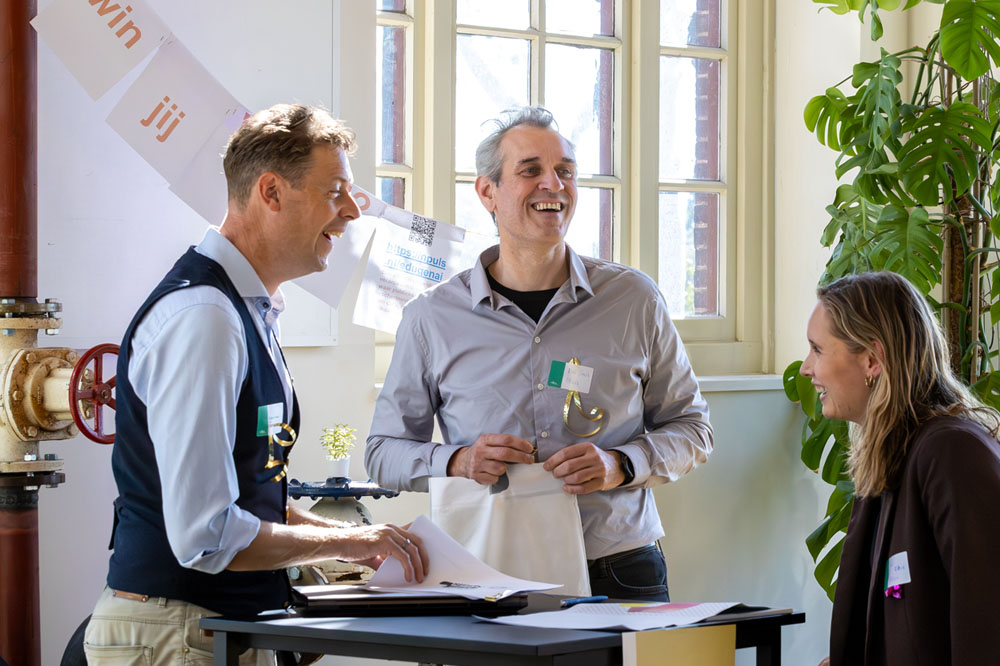
Those questions were addressed during the event "AI in education, learning by doing" last Oct. 1 at Saxion University of Applied Sciences in Deventer. Here Saxion, University of Twente and University of Bremen presented the results of their AI pilot projects, guided by the Education work area of AIC4NL. Both projects and this event were made possible by the Ministry of Education, Culture and Science.
AI applied in education
The two pilot projects demonstrate how AI solutions can enhance educational quality. "By a large group of people, great results have been achieved over the past year and many lessons have been learned, that really deserves to be celebrated today," said Julia van Wijk, coordinator of the Education work area at AIC4NL.
The pilots are examples of how collaborations between colleges, universities and partners accelerate innovation and enable societal impact. In doing so, they align with the mission of AIC4NL's Education work area: responsible deployment of AI that improves education.
Learning more in less time with AI feedback for trainee teachers
The University of Twente and University of Bremen developed the AI tool HAI FIVE, which provides feedback on instructional videos of trainee teachers.
"Providing good explanations during the lesson is not easy. With our tool we create an extra feedback moment that benefits the trainee teacher and saves the teacher educator time," explained project leader Ilona Friso-van den Bos.
HAI FIVE also showed how important it is to seek connections between different disciplines. "We underestimated beforehand how important it is to build bridges. It took a lot of time to develop a common language and way of working. However, this is crucial in multidisciplinary teams," said Professor Kim Schildkamp.
AI chatbot offers students 24/7 study help
Saxion presented sAxI, a chatbot that provides students with 24/7 answers to all kinds of study-related questions: from opening hours to resit policies and from BSA norms to support questions.
"Students get just-in-time, complete and coherent answers to their questions, based on reliable Saxion sources. This helps prevent study delays and gives study coaches more time and space for more complex questions," program manager AI in education Annemieke Bosshardt told us during her presentation.
The implementation also brought surprises. "The beauty of AI is that it can translate complex information into ordinary human language. But that is also an immediate problem: AI sometimes makes up data that is not there and has trouble with source citations," appointed project leader Richel Zandgrond.
Education remains human work
Richard Wielinga, member of Saxion's Executive Board, emphasized the broader significance of these pilots: "AI is going to change the world, including education. Of course the role of the teacher remains very important for human connection and inspiration, but the question of how that role will develop in the future I find exciting."
With the pilots, Saxion and the University of Twente & Bremen are showing that AI is not a distant future, but already has valuable applications today. Provided it is used carefully and responsibly.
The afternoon concluded with a stimulating keynote by tech philosopher Rens van der Vorst on the relationship between humans and technology. He pointed out that technology is always changing us. Sometimes subtle, sometimes profound. "All software is a worldview encapsulated in code. The question is: what worldview do you then convey in education?"
He also cautioned against blind faith in data and AI: more data does not automatically mean more insight. "It's good to use technology," Rens said, "but never forget that education is ultimately about people, not algorithms."
From pilot results to scale-up in education
The delivery of the pilot projects does not mark an end point, but a start for further research on application and scaling up. The lessons from Saxion, University of Twente and Bremen are valuable input for other educational institutions that want to get started with AI.
As Jeroen Visscher, work area lead Education at AIC4NL, summed it up, "Experimentation is the key to learning. Together we discover where AI really adds value."