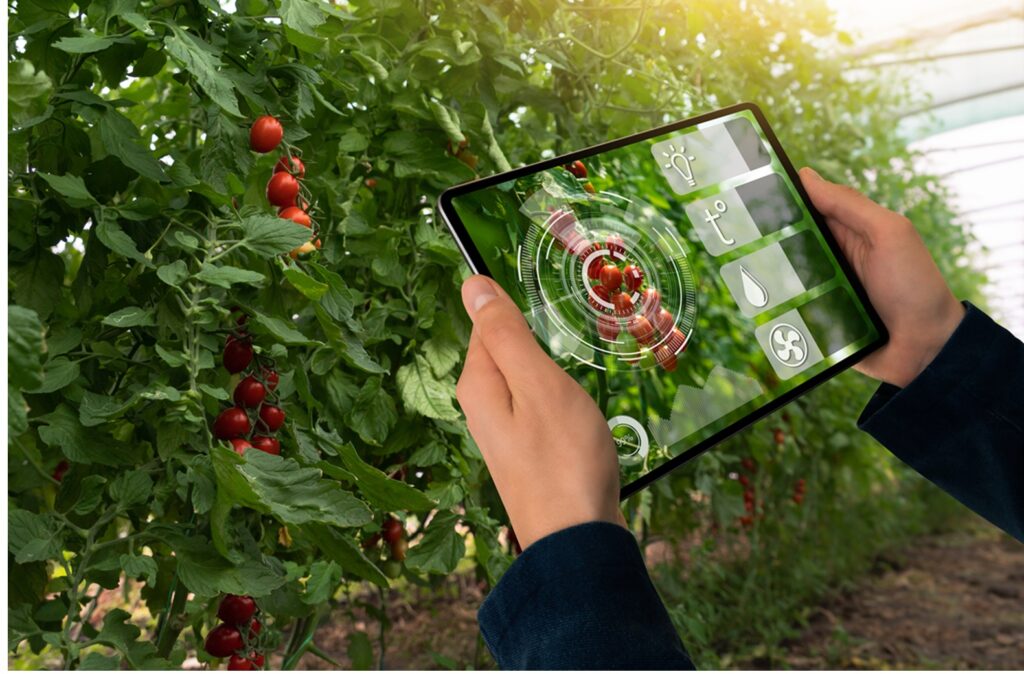
Worldwide, about a third of all food produced is wasted. A shockingly high percentage. Fruit and vegetables deserve extra attention, because it is not always possible to keep them fresh until the moment of consumption. OneThird has therefore developed a special scanner that can determine the quality of fruit and vegetable products at lightning speed. And AI plays an essential role in this.
A scanner that assesses the ripeness of an avocado in a split second. At CES 2023, an influential technology trade show in Las Vegas, that device drew a lot of attention. After all, who hasn't squeezed several avocados at the store only to find out at home that it wasn't the right choice after all? The CES presentation earned OneThird a lot of international publicity. And today, the scanner developed by this Enschede startup can be found in several supermarket chains, both at home and abroad.
The entire chain in view
In addition to supermarket customers, OneThird focuses on the entire chain, especially suppliers and distributors. Because the decisions they make based on expected shelf life determines where huge amounts of fruits and vegetables go. A wrong estimate can cause, for example, a large batch of strawberries, worth tens of thousands of euros, to be rejected. Besides being a financial disappointment, this is also painful because of food waste. And all this could easily have been prevented if the decision maker had better information.
Cutting is no longer necessary
"At OneThird, we see ourselves not so much as scanner builders, but primarily as suppliers of reliable data," emphasizes Ruben Hekster, CTO at OneThird. But he too knows all too well that without hardware, data cannot be collected either. "The big challenge here was to develop a scanner capable of imaging not only the outside but also the inside of fruit. This can be done with a multi-spectral camera that also captures wavelengths that you cannot see with the naked eye. The fruit therefore does not have to be cut through, as is common in the fruit and vegetable world during sampling. So our scanning method is non-invasive. The products we test remain intact. That, too, immediately leads to less waste."
Giant database
The next challenge: In order to make reliable predictions about the quality and shelf life of fruits and vegetables, OneThird had to collect quite a bit of data. "In cooperation with a number of partners, we have built up a gigantic database of reference scans in recent years. And thanks to the use of machine learning, our AI models are able to constantly learn from new data, making the predictions ever better."
Strawberries, tomatoes, blueberries and avocados
During the first pilot project, there was a scanner next to the packaging line that connected to a laptop with a cable, but now the scanner has bluetooth and makes full use of cloud functionality. So that device has become much more sophisticated. In several countries, suppliers and distributors are deploying the scanner on a large scale. OneThird is active in the Netherlands, England, Scandinavia, Spain, Morocco and Canada. In the process, the startup has long ceased to focus solely on strawberries: quality control of tomatoes, blueberries and avocados is now also among its capabilities. "There are six more products on our planning," Hekster indicates. "And eventually we want to offer a solution that is suitable for all types of fruits and vegetables."
Continuous improvement
"In order to scale up, it is important to be able to scan larger quantities of fruits or vegetables at the same time," he continues. "In terms of time, of course, it makes quite a difference whether you can scan a single strawberry or immediately a whole tray of strawberries. In the lab, we have already done tests for this with a special camera setup. That is also the project for which we received the MIT grant last year. And so we are trying to continuously improve our solution. And who knows: maybe our customers will soon be able to scan their products with their own cell phones. But that's really still in the future, because for that to happen, phones with multi-spectral cameras have to come on the market first, which could take years."
The European AI Regulation
OneThird spends a lot of time securing and anonymizing data and the reliability of their digital solution. "We do not fall under the risk categories that the European AI regulation looks at most, but it is of course very important that our customers have full confidence in the way we work. That's why we always work closely with our customers when developing new applications and use their feedback to make improvements quickly."
Small team
Helping to drastically reduce global food waste: that's a big and challenging goal. "When I hear how many fruits and vegetables are thrown away, sometimes my courage sinks in," says Hekster. "And we do this with a small team; there are only a dozen of us. In the meantime, it's taking off, we get a lot of positive feedback from our customers, and videos regularly appear on social media in which consumers share their experiences with our avocado scanner, which is just free marketing. So in the past three and a half years we have already made great strides."
A name change in 2030?
What also helps tremendously is that food waste is an issue that is gaining traction worldwide. This is in large part because one of the Sustainable Development Goals focuses specifically on that issue: in 2015, the UN stated that global food waste must be cut in half by 2030. A goal to which OneThird is eager to contribute. And if that SDG goal is met? Then it will require a name change. Because yes, OneThird is a reference to the current food waste rate. "But we will then lovingly make that name change," Hekster promises.
More information?
Visit OneThird's Web site. Or ask your questions via e-mail to Ruben Hekster.
Interested in the MIT scheme?
SMEs, including many startups, have an important economic and innovation role. Research shows that SMEs face many barriers in applying AI. The AiNed MIT AI call to bridge the gap between the knowledge base and application of AI innovations is supported from the AiNed program. This scheme will be repeated annually through 2026. The AiNed website will keep you informed.