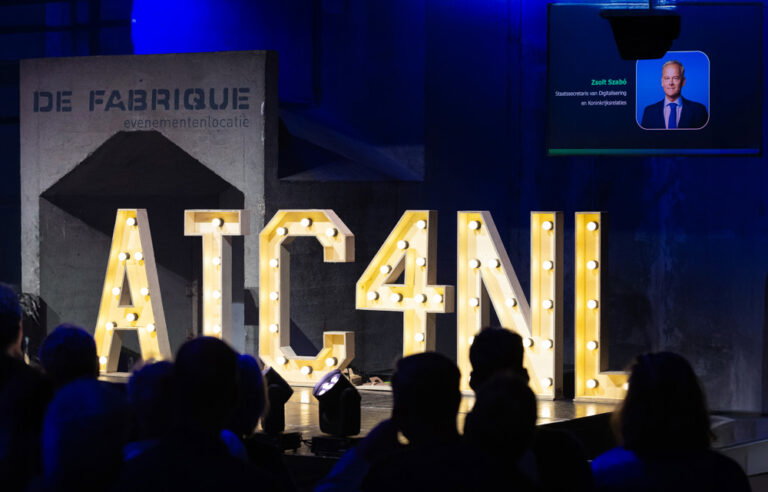
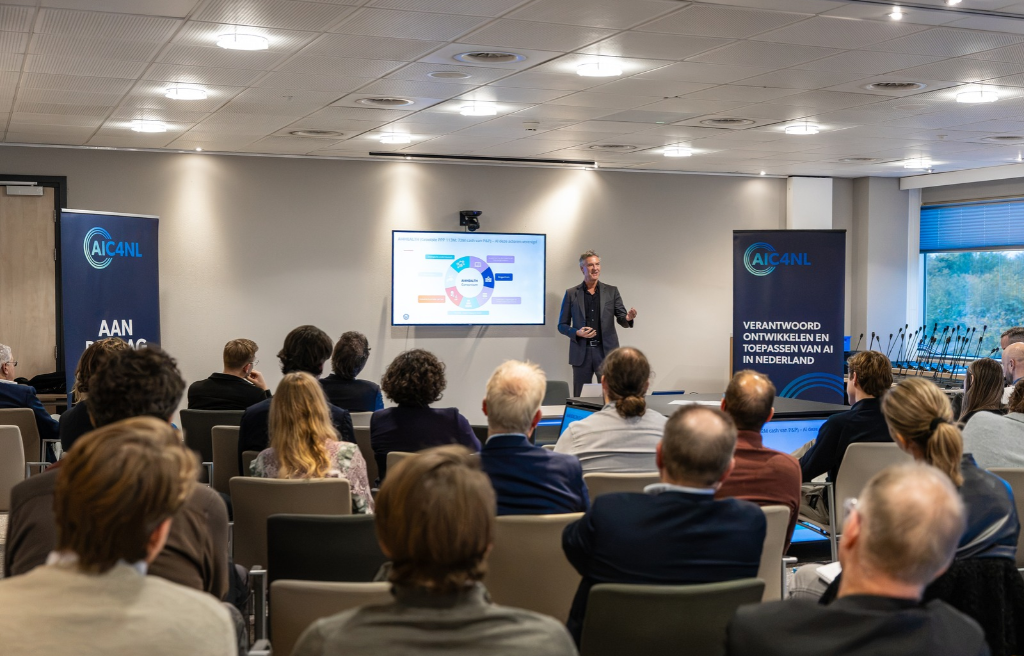
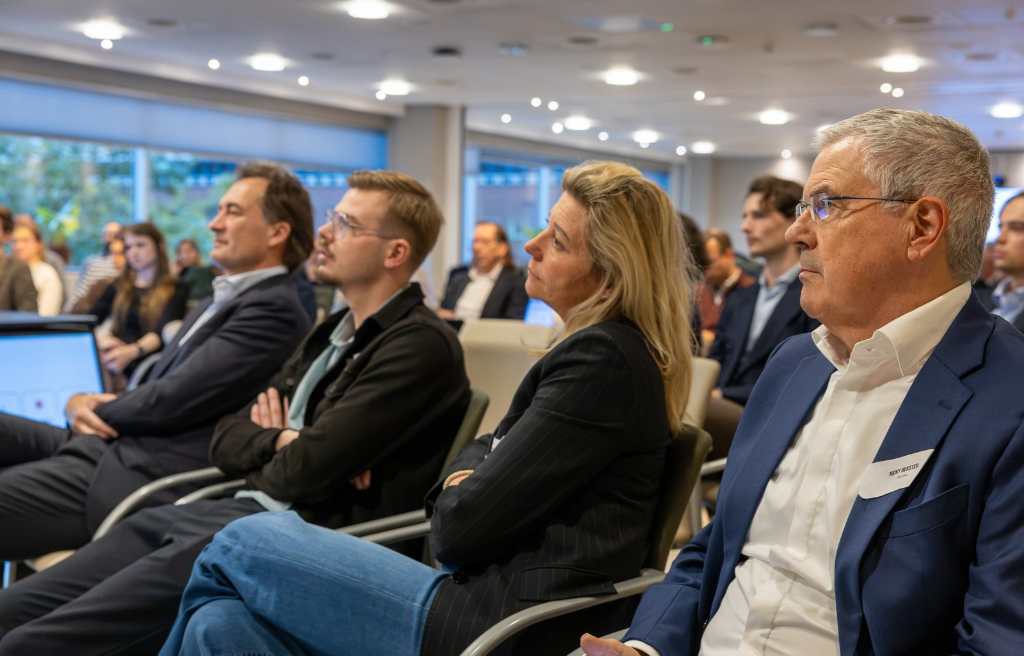
To connect the AiNed initiatives in the healthcare sector, AIC4NL brought together various AiNed initiatives with AI hubs, healthcare organizations, research institutions, and companies at the Malietoren in The Hague on October 27. These programs are delivering tangible results. AIC4NL actively links these initiatives to one another and to the larger AI programs in healthcare, thereby creating a learning AI healthcare network.
Representatives from the programs shared results, experiences, and insights and explored opportunities for collaboration and scaling up. The Ministry of Health, Welfare, and Sport (VWS) and health insurers also presented the breakthrough funding intended to scale up AI applications, along with the associated national support structure. The broader initiatives AI4HEALTH and MedTech 2035 were highlighted, and participants examined how the AiNed tracks could be logically linked to them.
The programs complement each other
AiNed is the largest AI program in the Netherlands. It is funded by the National Growth Fund and coordinated by AIC4NL. The components of the program complement one another. The ELSA Labs explore the ethical, legal, and societal aspects of AI, clarifying the conditions under which an application can be used responsibly. Innovation Labs bring together companies, research institutions, and healthcare organizations to rapidly translate AI ideas into practice within those frameworks. Learning Communities engage in use-case-based learning. The communities translate what they learn along the way into educational materials for the entire sector. Breakthrough Projects seek to resolve a specific bottleneck, such as making data available for AI. Use cases are continuously introduced to address current challenges in healthcare. Representatives from various labs, communities, and breakthrough projects shared exactly what they do and demonstrated the concrete results of the programs. Here is a small selection of these examples.

Nutri-Score for AI
Take, for example, the ELSA Lab Accountable Decision Support project at Radboud University. Project leader Johan Kwisthout is researching the decision-making process surrounding ENDORISK, an AI model that predicts the likelihood of uterine cancer spreading to the lymph nodes. The model works well and has been clinically validated, but it is not yet on the market because the CE marking required under the European Medical Device Regulation (MDR) poses a barrier. The lab aims to use this to learn how legislation should be implemented in practice. In the long term, Kwisthout wants to move toward a kind of Nutri-Score for AI, which compares products based on criteria such as verifiability and legal requirements. “It would be great if a hospital could say: we believe in using AI responsibly; we only purchase products with a minimum score.”
Dynamic consent
The PROSPER Innovation Lab is working on responsible data use for AI. To that end, the company Quantitas Solutions is building a dynamic consent module that allows patients to determine, for each type of data and each purpose, what may be done with their data. CEO Lucas Zielstra explained why this is necessary. One-time consent isn’t sufficient. “The use of data in healthcare is too broad. You don’t know in advance exactly what new purposes you’ll need that data for.” The hospitals in the consortium are testing the module, and starting in 2027, it will be operational in twelve hospitals. Following a so-called “sprint week” in September, the next one is scheduled for June 7–11, 2027. Would you like to join this initiative? Let us know at hello@prosperlabs.ai.
How exactly does a language model work?
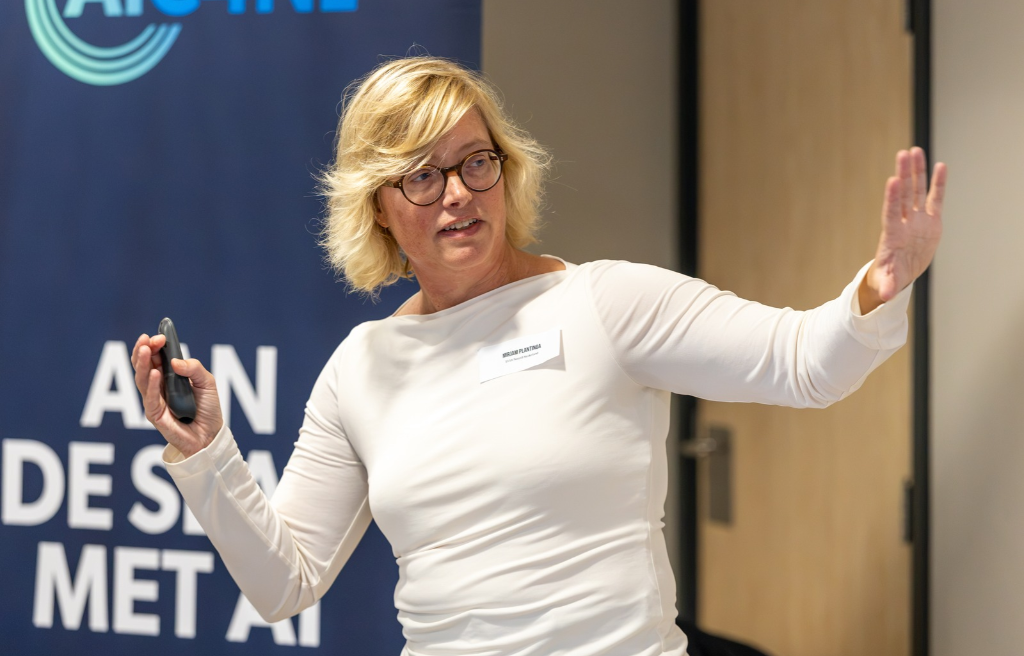
At the CARAI (Care for AI Readiness) Learning Community in Limburg, about 50 healthcare professionals take a ten-week course on a particular technology, after which they collaborate with students and IT companies. Marcel Schmitz of CARAI discussed the current use case, which focuses on generative AI and language models (LLMs) in healthcare practice. Healthcare professionals are taking a deep dive into how such a model works and learning when to use it and when not to. In a second ten-week phase, they explore how it can be applied in their own workplaces and identify the barriers to adoption. “Where are the barriers? What do we need to do? What can we develop to make this easier?” The answers are then incorporated into learning modules that are widely shared throughout the sector.
Breakthrough Strategies for Scaling Up
To scale up initiatives like these, the Ministry of Health, Welfare, and Sport (VWS) is making so-called “Breakthrough Funds” available . And for good reason. The healthcare sector is under pressure due to factors such as an aging population and staffing shortages. The Supplementary Healthcare and Welfare Agreement (AZWA) is intended to ensure that healthcare remains accessible and affordable. AI is one of the solutions for reducing the labor burden. For the period from 2027 through 2029, €800 million has been allocated for labor-saving innovations. The program focuses on areas where the greatest returns are expected.
For AI, the focus is specifically on voice-activated reporting and capacity planning. The goal is to give proven AI applications a boost. Arnoud Hartog, program manager at the Ministry of Health, Welfare, and Sport (VWS), explained during the afternoon session what this means for AI in healthcare. “The program is primarily aimed at achieving scale. This will truly give a boost to the use of AI in healthcare.”
Healthcare organizations can apply for grants from January 1 through January 31, 2027, to expand the use of AI applications. The model plans and guidelines are available at zorgakkoorden.nl, and the program plan “Implementing AI in Healthcare” describes the support available.
Innovation with AI is a broader movement
For the AiNed programs to truly succeed, it is essential to align with broader initiatives and turn AI in healthcare into a single, comprehensive learning network. For example, with its dynamic consent module, PROSPER does not want to become just another data silo and is therefore aligning with existing national initiatives, such as Mitz, the national consent platform. This way, patients have a single overview of their choices—both for healthcare itself and for research and AI. At the meeting, representatives from Mitz, the Ministry of Health, Welfare and Sport (VWS), the Dutch Health Insurers Association (ZN), Health-RI, and PROSPER—facilitated by AIC4NL—reached concrete agreements on close collaboration within the framework of the national AI healthcare learning network.
AI4HEALTH is a nationwide collaborative initiative . It brings together researchers, healthcare providers, companies, and government agencies in a ten-year program focused on AI in healthcare, led by Carl Moons (UMC Utrecht). AIC4NL is one of more than 35 partners, and the budget totals €112.6 million.
One day before the meeting, it was announced that an additional €110 million would be made available for the MedTech 2035 policy agenda, which aims to make the Netherlands home to the strongest medical technology sector in Europe.
The afternoon concluded with a discussion of how AI for healthcare fits into this picture, with a proposal for an additional flagship initiative. This will require national coordination to link existing programs—such as AZWA and Realisatie AI in de zorg—with funding and with scaling up efforts in the healthcare sector.