The AIC4NL coalition consists of more than 430 participants from the business community, government, and academia. What benefits does the network offer them?
NextHuman aims to strengthen public services and reduce inequality through responsible technology. This attracts talented people, as well as partners and like-minded individuals in the sector. “Our affiliation with AIC4NL has given our clients confidence.”
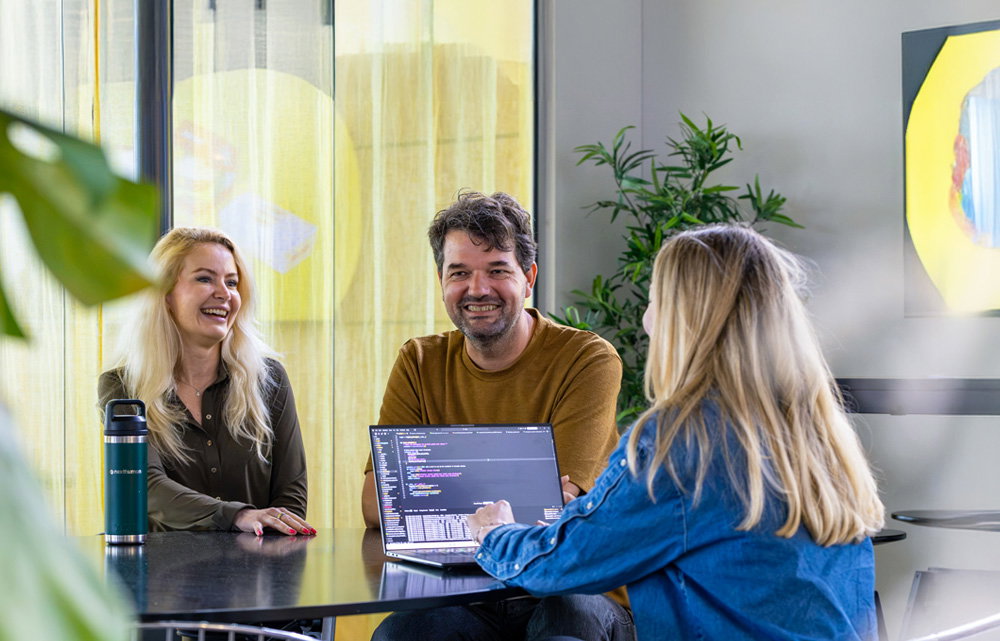
We spoke with the founders of NextHuman, Aoibhinn Reddington (CTO) and Nikki Wesselius (COO).In 2023, they launched a software platform designed to make it easier to help people transition from welfare to employment—using cutting-edge technology, AI, and a healthy dose of enthusiasm. The company now employs twelve people. How did they embark on this adventure?
Wesselius studied econometrics and worked at an American investment bank, and later at KPMG and PwC in Sydney, where she developed risk models for oil companies. It was there that she realized commercial organizations didn’t give her the fulfillment she was looking for. “What am I using my brain for?” she wondered. When she and Reddington came up with the idea of using innovative technology to help people in difficult situations, her interest was immediately piqued.
Reddington conducted neuroscience research at Erasmus MC, where she came across research using machine learning to predict epileptic seizures. “That’s when I really thought, ‘This is so cool—I want to build something like this.’” She graduated with a degree in electrical engineering and gained the technical expertise at Philips and Deloitte needed to develop an AI-powered platform. They found each other, and their shared mission became a reality.
Choosing the Mission
And that mission seems to resonate. Many IT companies struggle to find qualified people, especially women. Not NextHuman. According to Wesselius, helping vulnerable groups plays a role in this. “The people who work here have all had the opportunity to work at Microsoft, for example, or anywhere else, but they’ve made a very conscious choice to work here. I think Gen Z is extremely interested in mission-driven work.” In a male-dominated industry, NextHuman has no shortage of women. “Everyone is always surprised—we actually have to make an effort to hire men rather than women.”
The sector itself is also enthusiastic. Municipalities and employment development agencies are seeing job placements that otherwise wouldn’t have happened. These often involve people with a “job placement agreement” designation. You receive this designation from the UWV if, due to a disability, you cannot earn the minimum wage on your own but are able to work for a regular employer. Finding work is always difficult for this group. Wesselius tells the story of a counselor who had had a man on her caseload for two to three years. When she finally found him a job, she said to a colleague at NextHuman: “I could kiss you. I’ve finally found a job for this man.” Wesselius: “Those are the things that give us energy.”
“The people who work here have all had the opportunity to work at Microsoft, for example, or anywhere else, but they’ve made a conscious choice to work here. I think Gen Z is really interested in mission-driven work.”
Nikki Wesselius, COO of NextHuman
Sharing Experiences
So, there was a lot of positive feedback, but breaking into the public sector turned out to be a challenge after all. The standards are strict, and it takes time to build trust. Because this application involves access to employment and income, it falls under the “high-risk” category of the AI Act. For our first client, it took a year and a half before compliance was fully in order. Every client has a data protection officer (DPO), also known as a privacy officer. This is an internal privacy supervisor who assesses whether the software handles data responsibly. With subsequent clients, the process went much faster. “The DPO from that first client is in contact, through network organizations, with the DPOs of clients who joined us afterward, and they can learn a great deal from one another. About 80 percent of the compliance analysis is reusable. That saves us—and them—a great deal of time. Other parties can also learn from this process. That’s really a very valuable role for a coalition like AIC4NL,” says Reddington.
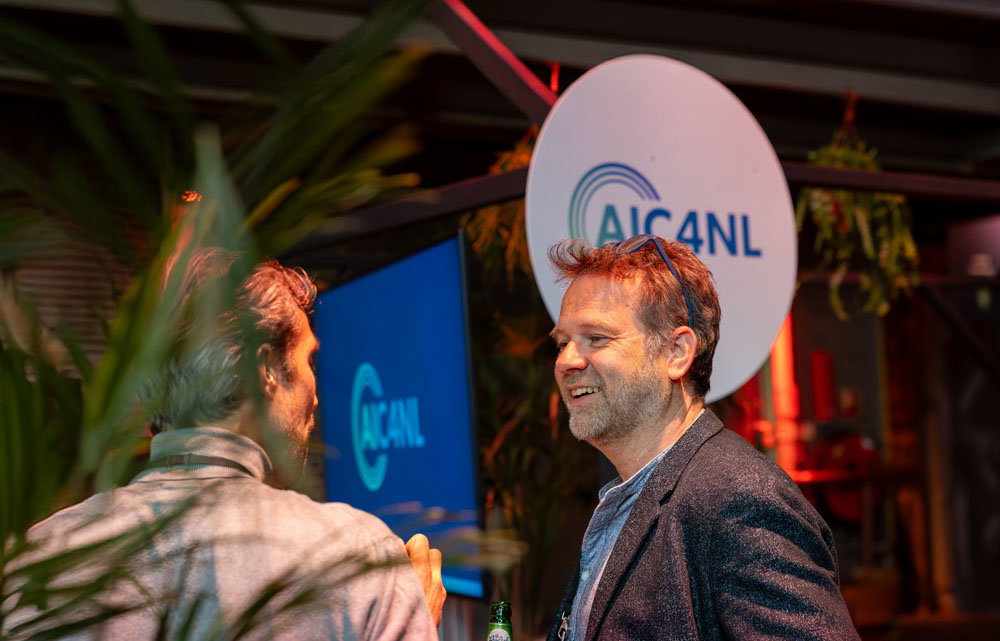
New clients also pay attention to membership. “Clients have actually asked us several times if we were members, and we were very happy to be able to say yes. That gave clients confidence. It may sound like a small thing, but it can be very important,” says Reddington. In addition, the NextHuman network connects the company with partners and like-minded individuals. After a lecture by Reddington on inclusion in the HR field, a college reached out. They saw common ground with the new “From School to Sustainable Work” Act. The college wants to prevent dropouts and understand how graduates find jobs that suit them and that they can keep. “They also have a lot of interesting analyses that run parallel to ours, such as predicting dropout rates. We really take that into account as well, especially when it comes to sheltered employees. When is someone at risk of dropping out?” explains Reddington. For Wesselius, that’s the value of such a network. “You’re there, you give your talk, and then you run into people again, and synergies emerge once more.” Next year, NextHuman also plans to participate in Breaking Barriers, the AiNed program from AIC4NL for AI startups and scale-ups facing barriers to growth. Discussions about this are already underway. “That program ensures that specialists in all kinds of fields can suddenly help you think through your organization and its growth,” Wesselius says, looking ahead.
“Customers have actually asked us a number of times if we were members, and we were really happy to be able to say yes. That gave customers confidence. It may sound like a small thing, but it can be very important.”
Aoibhinn Reddington, CTO of NextHuman
The Role of AI
How do you implement AI in an industry where data is highly sensitive and heavily regulated? Reddington explains how the platform differs from standard matching software. “In traditional recruitment, there are, of course, matching systems where you pair a candidate with a job opening. What skills does someone have? But in our industry, that’s simply not what you base a match on. Can someone lift above shoulder height? Does someone have childcare arranged so they can work those hours? Or is there another challenge? Can someone handle stress? It’s actually much more about getting the full picture of a person.” That information comes, among other sources, from conversations between the consultant and the candidate. These are recorded and transcribed, after which AI extracts the useful information.
Wesselius explains: “Of course, a counselor takes that into account as well, but it all has to be done mentally. They do know that someone might not be able to handle sensory stimuli or work well in a busy environment. But there’s no tool that can help find the right match in those situations. And some counselors have a caseload of two hundred people. In that case, it’s really quite difficult to keep track of all two hundred of them.”
AI as a Matchmaker
The AI acts as a sort of matchmaker. For example, the platform keeps track of developments in the region on its own. If a distribution center is being built, it searches its caseload for people who could work there. The account manager approaches the employer before the job posting goes online, presenting a candidate and the UWV’s “no-risk policy” as a selling point. Under this policy, the UWV pays the employer sick leave benefits if the new employee becomes ill, so the employer bears no financial risk.
The decision on whether to make such a proposal rests with the consultant. According to Reddington, the consultant can also use the proposal as a topic of discussion with the candidate. The consultant shows the candidate which steps and matches the system suggests and asks for the candidate’s opinion. “That feedback can then be incorporated, which in turn enriches the profile,” says Reddington. Candidates can also participate themselves through an app where, according to Wesselius, “you can ‘Tinder’ through job openings.”
Own servers
NextHuman works with sensitive data belonging to vulnerable people and views the responsible use of AI as a key part of its strategy. Sovereignty is part of that: determining for oneself where the data is stored and who has access to it, without being dependent on foreign tech companies. Functionally, there is little to criticize about the cloud services offered by major American tech companies, according to Reddington, but geopolitically, that dependence makes it risky. That carries significant weight, because, according to Wesselius, the data in question belongs to “the most vulnerable group of people, second only to children.” That dependence also poses a business risk, as prices for computing power or data storage could easily increase tenfold, according to Reddington.
That is why NextHuman is looking for alternatives. It is investigating whether the software can run on old servers that are no longer in use. The team is developing a software framework to make machine learning efficient enough on those older processors. The feasibility study is still ongoing, but if the experiment succeeds, this will become NextHuman’s new operating procedure. Data from the most vulnerable Dutch citizens will then remain in the Netherlands, on hardware that would otherwise be discarded.
The Netherlands can reduce its dependence on foreign technology companies by developing AI models for sectors in which the country has a strong international presence....
The European LLM-BRIDGE consortium has published an open call for incubators and innovation partners. The selected incubator will run a Venture Incubation Program...
As he steps down as chairman of the board of AIC4NL, Willem Jonker looks back on four years in which AI made a breakthrough among the general public...
The role of AI is growing rapidly, and it is having an ever-greater impact on our society. The government plays a role in this in three ways. As a legislator, it sets the framework for
To provide the best experience, we use technologies such as cookies to store and/or access device information. Giving consent to these technologies allows us to process data such as browsing habits or unique IDs on this site. Not giving consent or withdrawing consent may adversely affect certain features and capabilities.
Functional
Always active
The technical storage or access is strictly necessary for the legitimate purpose of enabling the use of a specific service explicitly requested by the subscriber or user, or for the sole purpose of carrying out the transmission of a communication over an electronic communications network.
Preferences
The technical storage or access is necessary for the legitimate purpose of storing preferences that are not requested by the subscriber or user.
Statistics
The technical storage or access that is used exclusively for statistical purposes.The technical storage or access that is used exclusively for anonymous statistical purposes. Without a subpoena, voluntary compliance on the part of your Internet Service Provider, or additional records from a third party, information stored or retrieved for this purpose alone cannot usually be used to identify you.
Marketing
The technical storage or access is required to create user profiles to send advertising, or to track the user on a website or across several websites for similar marketing purposes.