The Netherlands can reduce its dependence on foreign technology companies by developing AI models for sectors in which the country has a strong international presence. By pooling specialized knowledge and data, new opportunities for innovation and economic growth emerge. But how do we ensure that this collaborative AI technology remains accessible in the long term? In a new position paper, AIC4NL therefore advocates for stewardship governance: a way to sustainably protect the strategic AI foundation while allowing companies the freedom to do business and compete.
Don't compete on scale, but on knowledge
AI models form the technological foundation of many AI applications. They learn to recognize patterns and correlations in large amounts of data and can use this ability to, for example, generate text, make predictions, or analyze complex information. Well-known applications such as ChatGPT use large, general-purpose AI models that can be deployed for a wide range of tasks.
The development of these general-purpose AI models is dominated by a small number of international technology companies, which are investing hundreds of billions in infrastructure, computing power, and talent. It is hardly realistic for the Netherlands to compete on that scale. But the Netherlands has another asset: internationally distinctive knowledge and valuable data in areas such as water management, agri-food, high-tech, and logistics. These areas present opportunities for domain-specific AI models: models tailored to the knowledge, data, and specific challenges of a particular sector. By bringing this knowledge and data together, a shared technological foundation is created upon which various companies and organizations can develop their own applications.
This not only offers opportunities to reduce dependence on large international technology companies, but also strengthens the innovative capacity and earning power of Dutch sectors. By sharing development costs and combining knowledge and data, startups and small and medium-sized enterprises also gain access to AI capabilities that would be difficult for them to develop on their own.
Collaboration requires clear agreements
The development of a shared AI platform also raises important questions. Who owns the technology? Who gets access to the models? And who determines the terms under which companies can use them? This becomes even more relevant when participants are also competitors, or when one of the companies involved is acquired.
Without clear agreements on ownership, access, and control, organizations may be reluctant to share their valuable knowledge and data. Good governance is therefore not only an administrative prerequisite, but also essential for joint investment and innovation.
Stewardship: Protecting What Is in the Common Interest
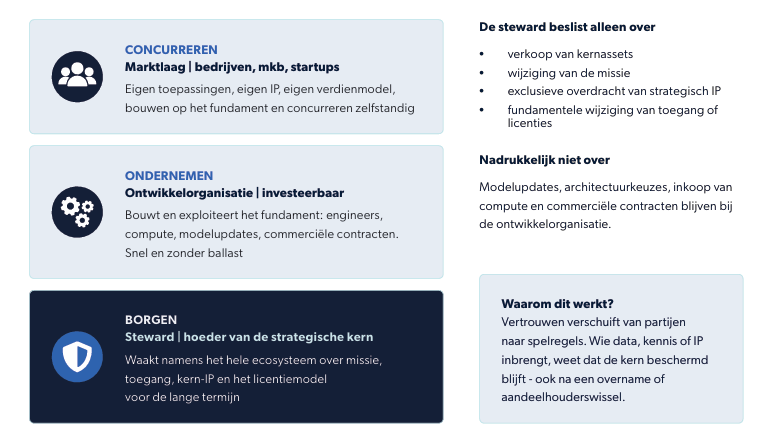
AIC4NL therefore advocates for stewardship-based governance. Under this approach, the strategic core of the shared AI technology is protected in the interest of the entire sector, including in the long term. Fundamental decisions regarding, for example, access, the mission, and shared intellectual property are safeguarded separately.
At the same time, there is still room for entrepreneurship. A professional development organization can further develop and commercialize the technology, while companies use it as a basis to develop their own products and services and compete with one another.
The guiding principle is: collaborate on the fundamentals, compete on the applications.
Three Recommendations for the Netherlands
To encourage the development of domain-specific AI models, AIC4NL makes three recommendations:
- Start with the areas where the Netherlands excels. Focus development efforts on sectors with internationally distinctive expertise and data, such as water management, agri-food, high-tech, and logistics. Begin with a limited number of concrete initiatives to develop and test the approach in practice.
- Enshrine stewardship in legislation. Ensure that the proposed stewardship company is also suitable for a shared AI infrastructure in which multiple independent organizations participate. Incorporate this principle into the development of a European legal entity.
- Let the private sector take the lead. The business community must drive this development, supported by the government through measures such as access to AI infrastructure, research, innovation, and appropriate legal frameworks.
Building Your Own AI Strategy
With this third position paper, AIC4NL builds on its earlier calls for a Dutch AI investment agenda and a coherent European AI industry policy. The new publication provides further details on strengthening strategic Dutch sectors through domain-specific AI models. It adds an important perspective to this: how can we ensure that jointly developed AI technology remains accessible in the long term and does not become dependent on the interests of a single dominant party?
By combining technological development with sustainable governance, the Netherlands can make better use of its specialized knowledge, increase the earning power of various sectors, and strengthen its digital sovereignty.
Read the full position paper, " Domain-Specific AI Models."