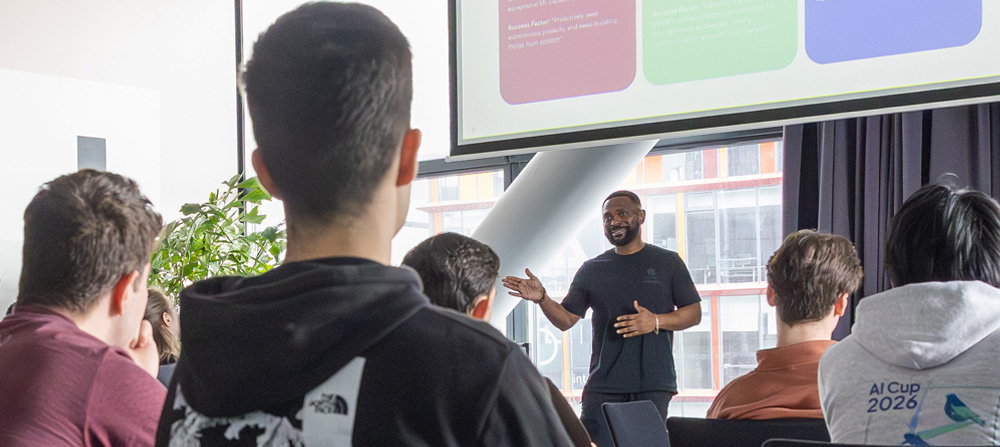
Our voices contain a remarkable amount of hidden information. Think of gender, age, or where someone is from. But there’s more. Subtle nuances in the voice can reveal diseases such as Alzheimer’s and Parkinson’s. And if you listen closely, you can hear patterns that reveal why some children struggle to learn to read. AI is good at recognizing such nuances and patterns. But precisely because our voices contain so much information, safeguarding privacy is of the utmost importance in this context.
The Responsible AI for Voice Diagnostics (RAIVD) research group is supported by a Fellowship Grant and is conducting research in this area. It trains and tests AI models using voice recordings to detect Parkinson’s disease, Alzheimer’s disease, and reading difficulties. The project consists of six doctoral research projects. The privacy of voice data is a central theme throughout the project.
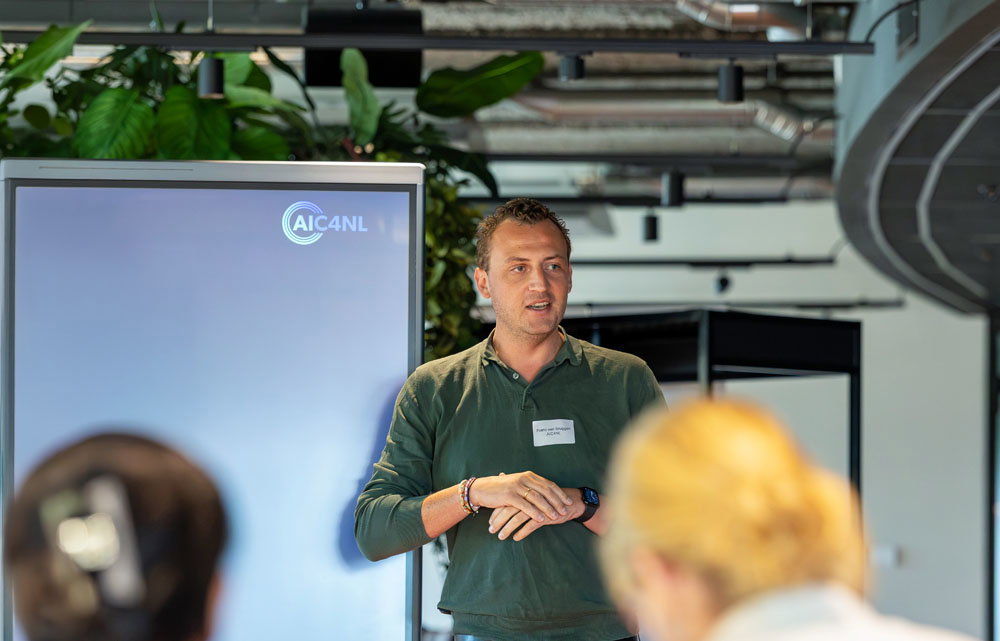
We spoke with Cristian Tejedor-García, an assistant professor at Radboud University’s Center for Language Studies and leader of the research group, about this study. “We are getting better and better at protecting our voices, and we can use them to detect potential conditions early on,” Tejedor-García summarizes.
The Nuances of Parkinson's and Alzheimer's
According to Tejedor-García, our voice is one of the easiest biomarkers to measure. It’s a clearly measurable signal that provides insight into your health. On the healthcare side, the team is conducting research on Parkinson’s and Alzheimer’s in collaboration with Radboudumc. The researchers are investigating whether it is possible to detect these diseases at an early stage based on a person’s voice—and whether they can then be distinguished from conditions with similar speech problems, a process known as differential diagnosis. Tejedor-García previously summarized the current state of the science in a review study on voice-based Parkinson’s detection.
The team is now seeing its first results. According to Tejedor-García, the models correctly identify 80 to nearly 90 percent of cases of early-stage Parkinson’s disease. In later stages, when symptoms are more pronounced, that figure is around 95 percent. Tejedor-García does, however, offer a caveat. “We’re almost there, but only under very specific circumstances, within very specific domains, and for very specific tasks.”
According to Tejedor-García, there is still a lot of work to be done before these models can be used in the doctor’s office. “A number alone isn’t enough for a neurologist. Suppose we’re 90 percent certain that this patient has Parkinson’s. Then we also have to show why. We need to provide examples. There needs to be an explanation of how the model works internally. That’s not easy.” The team is working hard on this. For example, Ph.D. candidate Yi Zhong developed a model that recognizes Parkinson’s and shows what it’s based on, such as pitch and rhythm. The team then published the first benchmark for speech-based EarlyPD detection. The next step is to make the explanation simple enough that even someone who isn’t an AI expert can understand it.
The algorithms are fine, and we have enough computing power. We need more data.
Cristian Tejedor-García, leader of the Responsible AI for Voice Diagnostics research group.
Help for Beginning Readers
On the educational side of the research, AI listens for other nuances in the voice. It focuses on reading difficulties in children who are learning to read. How often does a child pause while reading aloud? Which words do they hesitate on? Are letters mixed up? The answers are compared to an example of a text that sounds fluent.
To obtain useful results from this, the AI must understand exactly what a child is saying—even, or especially, when the child makes mistakes. Progress has been made in this area since the fellowship began. In 2024, the researchers first tested which existing speech recognition models best understood Dutch elementary school children reading aloud. A follow-up study in 2025 then linked the speech recognizer Whisper to a language model that knows which text the child is reading. The results were promising. The percentage of words misrecognized by the models dropped from 9.4 to 5.1 percent. The next step is to introduce the application into the classroom itself.
Together with the National Education Lab AI (NOLAI), the team is collecting speech recordings from classrooms. They do this using a protocol that includes word lists, texts, and stories that children read aloud. The recordings from the classrooms will be analyzed next year. These recordings will be used to further train and test the models to understand how children actually read aloud in the classroom, what mistakes they make, and how they can best be helped to improve their reading skills.
Keeping Your Voice Healthy
Using voices to make a diagnosis also carries risks. From a few seconds of speech, it’s possible to deduce your gender, age, or a medical condition you haven’t shared with anyone yet. The project only retains what is absolutely necessary. Parents, schools, and the children themselves receive a consent form that clearly explains what happens to the recordings. Afterward, the data is pseudonymized.
The audio recordings are stored securely at a physical location, while the key that links them to a specific child is kept somewhere else. The files are categorized using anonymous IDs. “I’m deliberately not saying ‘completely anonymized,’ because we need to be able to trace them back to the child somehow. That’s the trick here.”
The recordings themselves are also cleaned up. Anything unrelated to reading is removed. An algorithm anonymizes the speech content. If the team wants to share anything with the world, it’s the result: the trained model. The original recordings cannot be recovered from it. For medical speech, the team developed similar methods, such as a privacy risk analysis and a technique to protect speech data from Parkinson’s patients.
Data as an Obstacle
Tejedor-García is certain that there is much progress to be made with AI in healthcare and education. However, there is one obstacle that is difficult to overcome: data. Freely available datasets containing the voices of Parkinson’s or Alzheimer’s patients are virtually nonexistent. And the data used by the team at Radboudumc cannot be shared. Only the analyses are publicly available. “We are at a stage in our research where we need more data. The algorithms are sound, and we have sufficient computing power. We need more data from the field—high-quality data.”
The team is therefore trying to encourage other researchers to create open datasets, with privacy properly addressed from the outset. In education, data collection is easier, but not as fast as Tejedor-García would like. “There are more children than patients who want to participate in this. However, parental, school, and child consent is required for each data entry. In healthcare and schools, it’s difficult to obtain data and make it publicly available.”
Every language is different, and that makes collecting data even more difficult. A model trained on Dutch speech won’t necessarily work for a Spanish speaker. The difference between native speakers and non-native speakers also plays a role. “Even if we had a lot of data, we could only apply it to a single language,” says Tejedor-García, summarizing the data problem.
Retaining Talent in the Netherlands
Tejedor-García came to Nijmegen as a postdoc in 2021. When his appointment ended, he started looking for something new. At that time, budget cuts were affecting higher education, and securing a tenured position proved difficult. “I know many colleagues who had to leave the university.” The fellowship came at the perfect time. It secured him a position as an assistant professor and ensured that he would remain in the Netherlands. Tejedor-García recruited five international Ph.D. students and one Dutch student for his team.
The fellowship has two and a half years left. Healthcare, education, and privacy remain the three main areas of focus. There is still much to be gained, but the exact direction the research takes will depend on the data that becomes available. Tejedor-García sees two key conditions for AI to succeed in speech recognition. “We need to show doctors and make it clear what the added value of AI is. And we need to collect enough data to make the models reliable for everyone. AI is advancing at lightning speed. There are some really good models out there. But the problem of obtaining data remains the biggest challenge. We don’t know if that will be resolved anytime soon.”
About AiNed Fellowship Grants
AiNed Fellowship Grants help Dutch research institutions attract and retain top international AI talent. The grant funds the appointment of an AI researcher as an assistant professor, associate professor, or full professor. The Fellowship Grants are part of the AiNed National Growth Fund program and are administered by NWO.
As he steps down as chairman of the board of AIC4NL, Willem Jonker looks back on four years in which AI made a breakthrough among the general public...
Objection and appeal processes are resource-intensive for government agencies. There are large numbers of cases, complex regulations, and a great deal of administrative work...
With an AiNed Fellowship Grant, Dutch universities and research institutions attract top international AI talent to the Netherlands. The grant funds the appointment of an AI researcher as a (tenure-track) assistant professor, associate professor, or
AI is rapidly evolving from a specific digital technology into a systems technology that is transforming the economy, government, and society. This offers opportunities for productivity and innovation, but also raises questions
To provide the best experience, we use technologies such as cookies to store and/or access device information. Giving consent to these technologies allows us to process data such as browsing habits or unique IDs on this site. Not giving consent or withdrawing consent may adversely affect certain features and capabilities.
Functional
Always active
The technical storage or access is strictly necessary for the legitimate purpose of enabling the use of a specific service explicitly requested by the subscriber or user, or for the sole purpose of carrying out the transmission of a communication over an electronic communications network.
Preferences
The technical storage or access is necessary for the legitimate purpose of storing preferences that are not requested by the subscriber or user.
Statistics
The technical storage or access that is used exclusively for statistical purposes.The technical storage or access that is used exclusively for anonymous statistical purposes. Without a subpoena, voluntary compliance on the part of your Internet Service Provider, or additional records from a third party, information stored or retrieved for this purpose alone cannot usually be used to identify you.
Marketing
The technical storage or access is required to create user profiles to send advertising, or to track the user on a website or across several websites for similar marketing purposes.