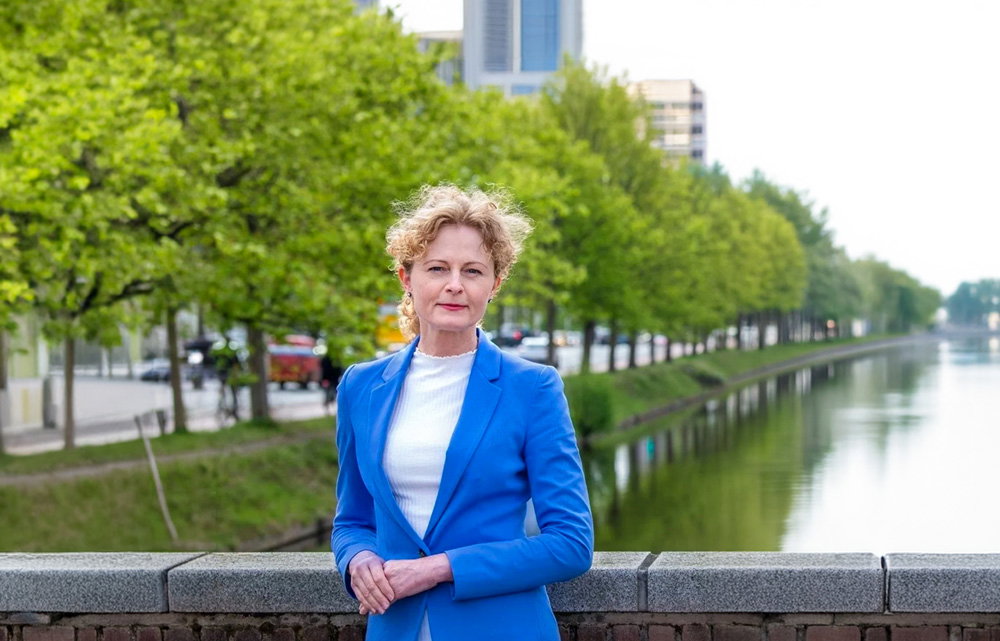
Nardie Scharenborg has been a board member of AIC4NL since November 1. She is part of the first generation of AI specialists to graduate in the Netherlands and has worked in the international business sector and for the Dutch government. What experiences does she bring to the table, and what does she hope to achieve?
1. You are part of the first generation of AI specialists to graduate in the Netherlands. Where did your fascination with AI begin, and how do you view the tremendous progress the field has made since then?
“In the 1980s and 1990s, AI achieved its first commercial successes. Organizations began using expert systems: programs that mimicked human expertise using thousands of ‘if-then’ rules. At the same time, artificial neural networks became increasingly effective at learning from data. Governments and companies invested billions.”
During that time, I began my studies and had the opportunity to be one of the first people in the Netherlands to graduate with a degree in AI. I combined courses in psychology and computer science: analyzing human expert behavior and developing expert systems. That’s how I became part of these fascinating developments.
The field then experienced various ups and downs. Expert systems proved to be expensive to maintain and inflexible. Researchers therefore developed systems that could recognize patterns in large amounts of data on their own—the foundation of today’s machine learning. Breakthroughs in computing power and the rise of the internet made new applications possible, such as speech recognition, image recognition, and search engines.
“With ChatGPT, generative AI went mainstream overnight on November 30, 2022. Technology that had long been accessible mainly to specialists became available to everyone. Developments are now moving at a dizzying pace. As humans, we must continue to handle this responsibly.”
2. You have worked on technological innovation and digital transformation in both the international business sector and the national government. What experiences will you bring to AIC4NL?
“I have worked for over thirty years in technical, consulting, management, and executive roles at international consulting and IT service providers, in sectors including transportation and logistics, telecommunications, the financial sector, and the government. The common thread throughout has been bringing together talented people and building teams or business units to make technological innovations practical and scalable.”
As an entrepreneur, I have also co-founded small businesses, attracted investors, and secured funding for new services and products. As CTO/CIO at SSC-ICT, one of the largest IT service providers for the Dutch central government, I was responsible for the strategic direction and led the delivery of services to more than 57,000 civil servants across seven ministries. Under my leadership, the sovereign AI platform “vlam” (secure local AI models) was developed and launched there.
"This career allows me to combine technical expertise, practical implementation skills, and administrative acumen. With these strengths, I aim to build bridges at AIC4NL between government agencies, research institutions, and private-sector partners in public-private programs."
Making technological innovations practical and scalable has been a common thread throughout my career. At AIC4NL, I want to bring together the knowledge, people, and resources needed to develop and widely implement AI responsibly in the Netherlands.
Nardie Scharenborg, Board Member of AIC4NL
3. At SSC-ICT, you worked on the safe and responsible use of AI within the government. What did you learn there about the opportunities and challenges of actually putting AI into practice?
“At SSC-ICT, we’ve worked with vlam to develop our own, independent AI platform that allows government officials to use generative AI while keeping government data under our own control. AI can also accelerate and support daily work processes on a large scale. The pilots showed high adoption and usage rates, with 77% positive results in test environments. Joining forces is essential to develop and roll out such solutions. The Ministry of the Interior and Kingdom Relations, as the launching customer, provided the initial funding. This enabled us to procure hardware, software, and AI expertise.”
At the same time, many applications are not immediately permitted in the public cloud due to privacy, security, and legal requirements. This caution conflicts with the desire to innovate quickly. Sensitive government data cannot simply be transferred to external tech companies or across borders, while sovereign solutions can be technically and organizationally complex to scale up. Shifting policies, changes in government, and varying frameworks within ministries make this even more challenging.
"At AIC4NL, I want to use that experience to bring together parties that can jointly organize technology, financing, and administrative conditions."
4. The Netherlands faces major challenges in strengthening its position in the field of AI. Where do you see the most significant opportunities, and what is needed to accelerate the development and application of AI?
“The key lies in accelerating AI innovation and its widespread adoption in existing business processes, particularly in strategic sectors such as healthcare, energy, agriculture, and defense. This requires a domestic AI industry and investments in three interrelated areas: infrastructure, technology, and applications.”
Companies and research institutions need affordable access to computing power, for example through European facilities and the AI factory in Groningen. Open models offer opportunities to further develop our own capabilities and become less dependent on foreign tech giants. We must then leverage that technology for practical, scalable applications.
The Netherlands does not have the deep pockets of the United States and China. According to AIC4NL’s AI investment agenda, at least €5 billion will be needed over the next five years to bring our AI position up to the level of frontrunners such as Scandinavia. In addition, clear, measurable frameworks and room for growth are needed, without piling unnecessarily strict national regulations on top of European legislation.”
5. What appeals to you about AIC4NL’s mission, and what do you hope to achieve as a board member?
“The balance between innovation and responsibility. Human autonomy and ethical frameworks are essential for public support. Bringing together government, academia, startups, and small and medium-sized enterprises is also something that resonates with me. By doing so, we prevent fragmentation, pool our innovative strength, and strengthen our digital sovereignty.”
I am honored to build on the work of my predecessors, including Willem Jonker and Saskia Vlaar. I want to further shape and steer public-private programs, strengthen ties with participants and the broader business community, and actively engage, expand, and connect regional AI networks.
Making technological innovations practical and scalable has been a common thread throughout my career. At AIC4NL, I want to bring together the knowledge, people, and resources needed to develop and widely implement AI responsibly in the Netherlands. I look forward to making this a reality together with the amazing team at AIC4NL, our participants, and our partners.”
The Netherlands can reduce its dependence on foreign technology companies by developing AI models for sectors in which the country has a strong international presence....
The European LLM-BRIDGE consortium has published an open call for incubators and innovation partners. The selected incubator will run a Venture Incubation Program...
To provide the best experience, we use technologies such as cookies to store and/or access device information. Giving consent to these technologies allows us to process data such as browsing habits or unique IDs on this site. Not giving consent or withdrawing consent may adversely affect certain features and capabilities.
Functional
Always active
The technical storage or access is strictly necessary for the legitimate purpose of enabling the use of a specific service explicitly requested by the subscriber or user, or for the sole purpose of carrying out the transmission of a communication over an electronic communications network.
Preferences
The technical storage or access is necessary for the legitimate purpose of storing preferences that are not requested by the subscriber or user.
Statistics
The technical storage or access that is used exclusively for statistical purposes.The technical storage or access that is used exclusively for anonymous statistical purposes. Without a subpoena, voluntary compliance on the part of your Internet Service Provider, or additional records from a third party, information stored or retrieved for this purpose alone cannot usually be used to identify you.
Marketing
The technical storage or access is required to create user profiles to send advertising, or to track the user on a website or across several websites for similar marketing purposes.