Modern artificial intelligence (AI) systems are becoming increasingly powerful but also entail ever-greater burdens, such as energy consumption. In his project, funded by the National Growth Fund’s AiNed program, Guangzhi Tang is investigating a radically different approach to AI computations, inspired by the human brain. “Computations using neural networks are often described as being inspired by the brain, but the way they actually compute differs greatly from how the brain works,” says Tang.

The research is part of AiNed XS Europe, which is coordinated by AIC4NL and carried out in collaboration with NWO (the Netherlands Organization for Scientific Research). These relatively small, short-term research projects lay the groundwork for larger European collaborations and the AI innovations of tomorrow. Now that the projects have been completed, we’re looking back on the results together with the researchers.
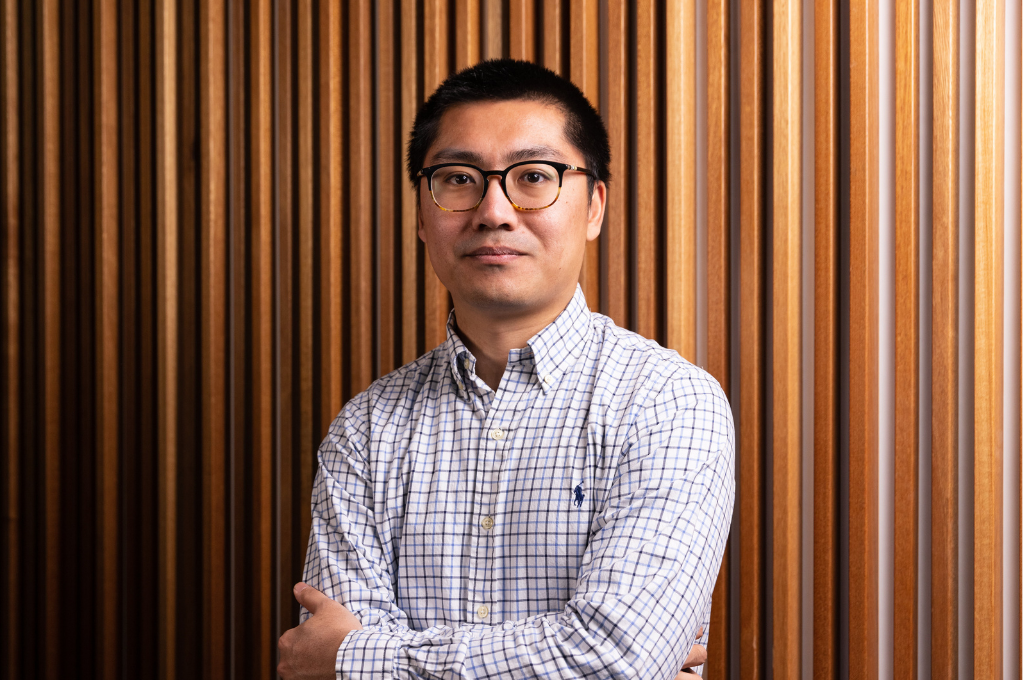
Text: Aafje Sierksma | Photo: Guangzhi Tang
Biological efficiency
Most current AI systems are based on matrix computations, a method that requires a constant data transfer, which is extremely energy-intensive. Instead of continuous, synchronized processes, the brain uses neurons that communicate via spikes—short, discrete signals that occur both sporadically and asynchronously. Neurons do not wait for complete information before acting. “In the brain, signals are only transmitted when something meaningful happens,” says Tang. This biological efficiency has long inspired researchers, including those working on neuromorphic hardware—computer chips designed to mimic neural behavior.
Removing the final barrier
Although neuromorphic hardware is designed to function like the brain—that is, asynchronously—most AI training methods still rely on traditional, step-by-step synchronous approaches. “We have developed a fully event-driven, asynchronous training method,” says Tang. “This allows neural networks to be trained in the same way the brain works, without resorting to those synchronized matrix calculations.”
The project is a collaboration with the Chair of Highly-Parallel VLSI Systems and Neuro-Microelectronics at TU Dresden, which houses a unique neuromorphic supercomputer. Although Tang and his collaborators already knew each other, the AiNed project enabled a much more intensive collaboration. “For the first time, we were able to truly test our ideas on a large neuromorphic system,” says Tang. “That was essential for validating our approach.”
Scaling Up
At present, energy efficiency has already been improved at the prototype level compared to traditional approaches. The transition from an academic setting to industry requires scaling up not only the algorithms and training data but also training efficiency. Tang and his partners are now preparing follow-up research proposals with industry partners to continue this work. “If the use of AI continues to grow, it could overload the European energy system,” he explains. “Our findings can directly contribute to European startups building energy-efficient neuromorphic hardware.”
Personal and Academic Impact
For Tang, this was his first grant since he began working at Maastricht University. It gave him a strong start in developing his own line of research in the field of energy-efficient AI. The project’s success also contributed to his appointment as an assistant professor in the Department of Advanced Computing Sciences. “The energy costs of AI are not just an economic issue, but also a social and humanitarian one. The academic world has a responsibility to take action and proactively address these challenges before it’s too late,” Tang emphasizes.
About the National Growth Fund (NGF) AiNed XS Europe
The NGF AiNed XS Europe call, developed in collaboration with NWO, has funded forty one-year projects that enable researchers to conduct curiosity-driven, high-risk AI research in collaboration with European partners. It supports the rapid exploration of bold ideas where the outcomes are uncertain, but every result contributes to scientific progress. Participants in the NGF AiNed XS Europe call evaluated each other’s proposals. “This was not only an evaluation task but also a valuable learning experience, which demonstrated how a strong problem definition and a clear methodology truly make a difference when ranking funding applications,” said Tang.
Source:NWO