
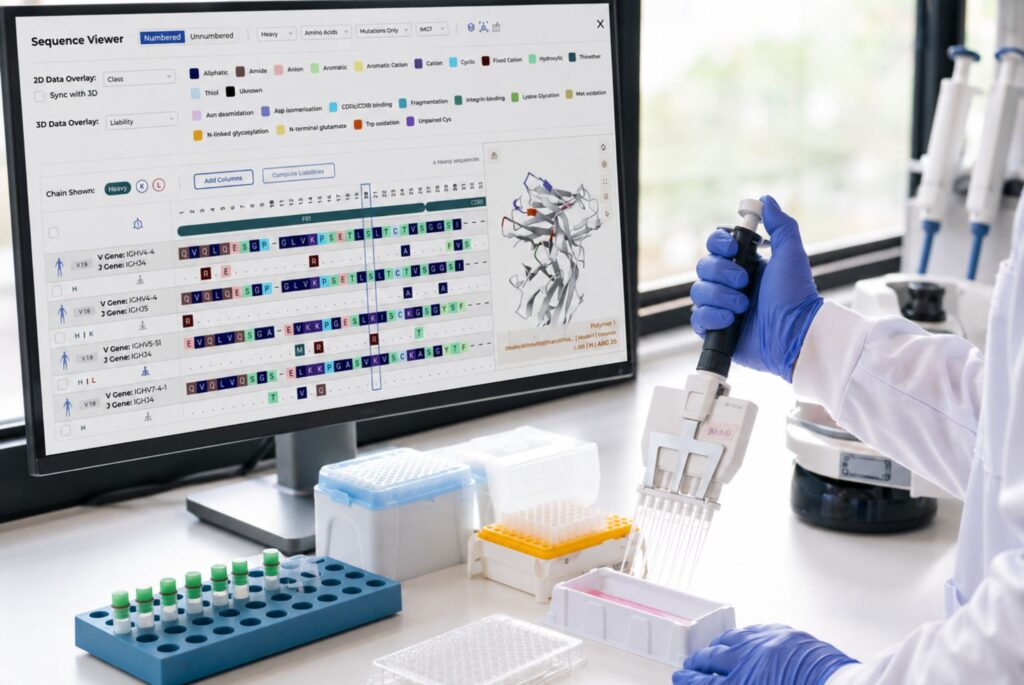
ENPICOM and Imuno Therapeutics are collaborating to build an end-to-end AI pipeline for the discovery and development of therapeutic antibodies against tumors. Through their TACIDO project, they are identifying, selecting, and optimizing antibody candidates more quickly and reliably, enabling promising immunotherapies to advance to further development sooner.
TACIDO is one of the MIT AI projects funded in 2025. This program supports consortia of small and medium-sized enterprises that collaborate to develop, test, and implement AI technology within the areas of focus of the AI Coalition.
Pooling expertise
ENPICOM is developing a bioinformatics and AI platform for biologics discovery. It brings together laboratory data, sequencing data, machine learning, and analysis workflows for lab and data scientists. Imuno Therapeutics is working on precision immunotherapy for hard-to-treat cancers and is developing highly specific TCR-mimic antibodies that target peptide-HLA complexes on tumor cells. Together, they combine data infrastructure, AI models, and experimental immunology into a single development pipeline.
From data to candidate
The core of TACIDO lies in translating complex biological data into better antibody candidates. The project is building an integrated pipeline that more intelligently links target selection, candidate generation, screening, prioritization, and optimization. This brings each step in the development process closer together.
The Role of AI
AI identifies patterns in large datasets and predicts properties such as binding affinity, specificity, developability, and potential risks at an early stage. This allows the most promising candidates to be identified more quickly. TACIDO thus makes the development of tumor-targeted antibodies more efficient, more targeted, and more scalable.
Toward new immunotherapies
By combining bioinformatics, synthetic and experimental data, AI models, and therapeutic expertise, ENPICOM and Imuno Therapeutics are shortening the path from discovery to therapeutic candidate. The project supports the development of new immunotherapies that target tumor cells more specifically and, in the long term, contribute to better treatment options for cancer patients.