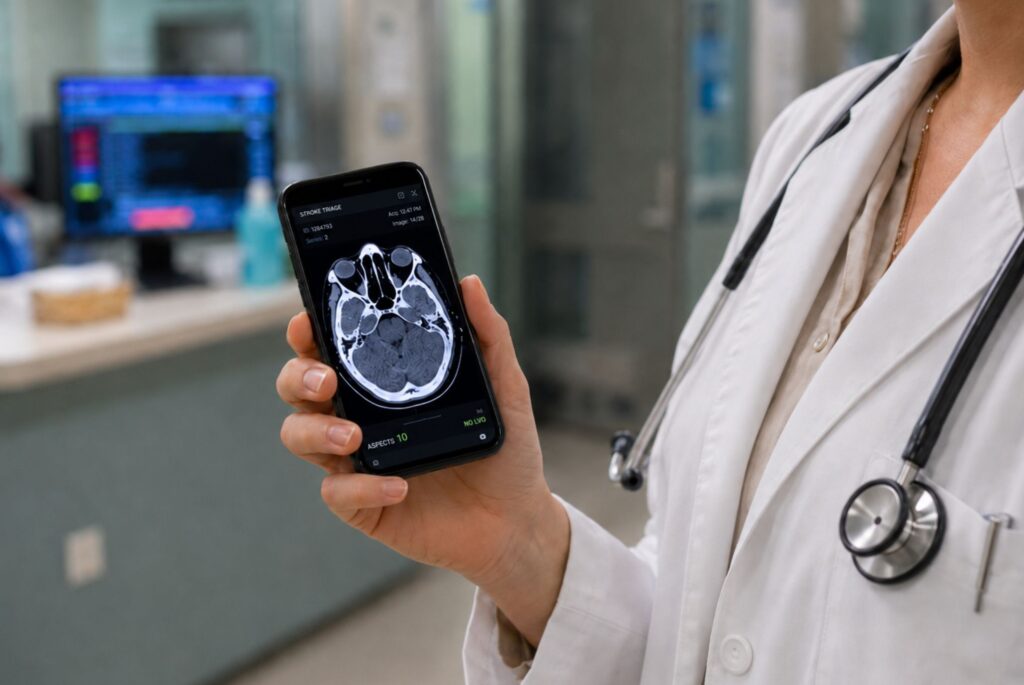
Nicolab and Founda Health are collaborating to build an AI platform that combines medical imaging and patient data to enable faster and more reliable decisions in stroke care. Through their NEURAL project, they are integrating real-time image analysis, clinical information, and secure data exchange, enabling care teams to more quickly determine the most appropriate treatment and referral for each patient.
NEURAL is one of the MIT AI projects funded in 2025. This program supports consortia of small and medium-sized enterprises that collaborate to develop, test, and apply AI technology within the areas of focus of the AI Coalition.
Joining forces
Nicolab develops AI-powered technology for acute stroke care, including StrokeViewer: a cloud-native platform that analyzes medical images, facilitates data exchange within regional stroke networks, and assists clinicians with time-critical decision-making. Founda Health brings expertise in interoperability and healthcare data infrastructure and makes patient information, documents, and images available across different systems and workflows, based on standards such as HL7, FHIR, DICOM, and IHE. Together, they connect AI diagnostics with the data layer that delivers insights to the right care team at the right time.
Image and context together
The core of NEURAL lies in combining imaging with context from the patient’s medical record. The platform brings together relevant information into a single decision-support workflow: CT and perfusion images, image features recognized by AI, clinical data, medical history, and information for triage, treatment, or transfer between hospitals. By presenting this information in an integrated manner, the platform supports faster interpretation, better coordination between radiologists, neurologists, and interventional teams, and greater certainty in the acute care pathway.
When every minute counts
NEURAL makes stroke care more data-driven, consistent, and scalable. By securely combining medical imaging and patient data, healthcare professionals gain a more complete picture of the patient sooner and can act more quickly when every minute counts. In this way, the project contributes to better treatment choices, more efficient regional collaboration, and more reliable decision-making in one of the most time-critical areas of acute care.