
With Breaking Barriers, the legal tech company is taking the step towards scaling up and certification.
Artificial intelligence is slowly but surely finding its way into legal practice. At the same time, it raises questions about confidentiality, dependency, and control. After all, what happens to sensitive files? And what if, in a few years' time, you want to switch to another AI platform but can no longer do so?
Founders Jason Stewart (Chief Commercial Officer) and Giles Slinger (Director of Product) are using Fledger to build AI software for lawyers with European sovereignty and data security as their starting point. They talk about their product LISA and how Breaking Barriers is helping them to grow.
More time for legal content
“AI is ideal for administrative tasks, such as analyzing intake forms, transcribing conversations, and compiling information. This leaves more time for substantive analysis and client meetings,” Jason explains. “As a result, lawyers can help more people within a future-proof business model.”
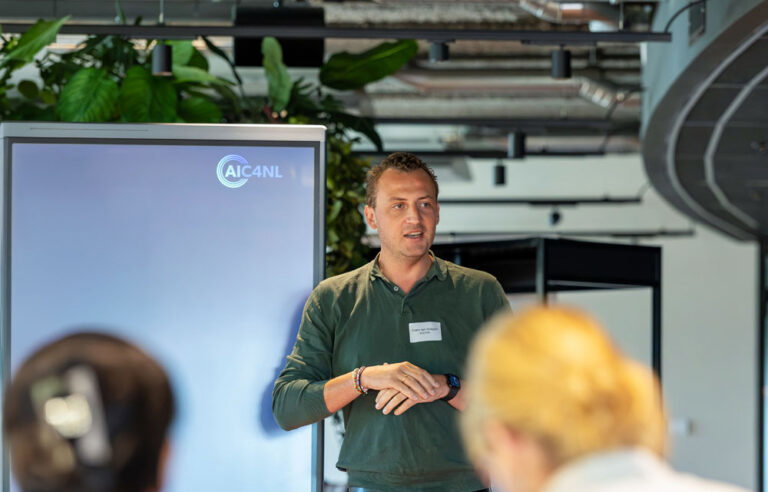
There is therefore a lot of interest in their self-developed AI assistant LISA, which handles legal research, file analysis, and knowledge management. Giles shows in a live demo how easy it is to use, even without AI knowledge: "Users work with their own documents, transparent source references, and personal templates, without the data being trained for other models." This is important, because if privacy matters anywhere, it's here.
No lock-in, but control over data
What sets Fledger apart: its focus on data sovereignty and privacy. The software is LLM-agnostic: customers are not tied to a single AI provider, and the data is easy to retrieve. "If you're just starting out with AI, dependency may seem abstract," Jason warns. "But in three years' time, AI will be fully embedded in your organization. What if geopolitical relations change? Then you need to have the freedom to move."
In addition, there is growing demand for European infrastructure and interoperability. Giles: "We are investigating European language models and expect to be able to add them to LISA soon. For some lawyers, this is a strict requirement, for others a valuable option. In any case, we want to give our customers a choice."
Strong foundation in technology
Fledger built its product from the ground up in The Hague, on the campus of The Hague Tech on Waldorpstraat. There, the founders came into contact with other tech companies, developers, and experts.
“That was a very valuable environment for us,” says Giles. “We met a lot of talented technical people there, exchanged knowledge with other teams, and found our own employees.” He beams as he makes this comment. “I am extremely proud of our tech team. In a short period of time, they built a complex product that works in practice and meets the needs of lawyers.”
Onward to a thousand lawyers
After intensive collaboration with law firms, LISA is now operational and ready for wider deployment. The next phase revolves around professionalization and upscaling. To this end, Fledger is joining forces with Breaking Barriers, which is supporting them with an EU-based AI infrastructure and a targeted marketing and sales process.
The product-driven focus remains the starting point. "That's why Breaking Barriers is so valuable to us," explains Giles. "By working with specialized partners, our tech team can continue to focus on what it does best: building, improving, and developing." The goal is clear: to have a thousand lawyers on board within a year, roughly one-eighteenth of the Dutch legal market. "But our mission transcends our product and our market," Jason concludes. "Digital independence and the freedom to switch between providers are relevant to every sector in the Netherlands and beyond."