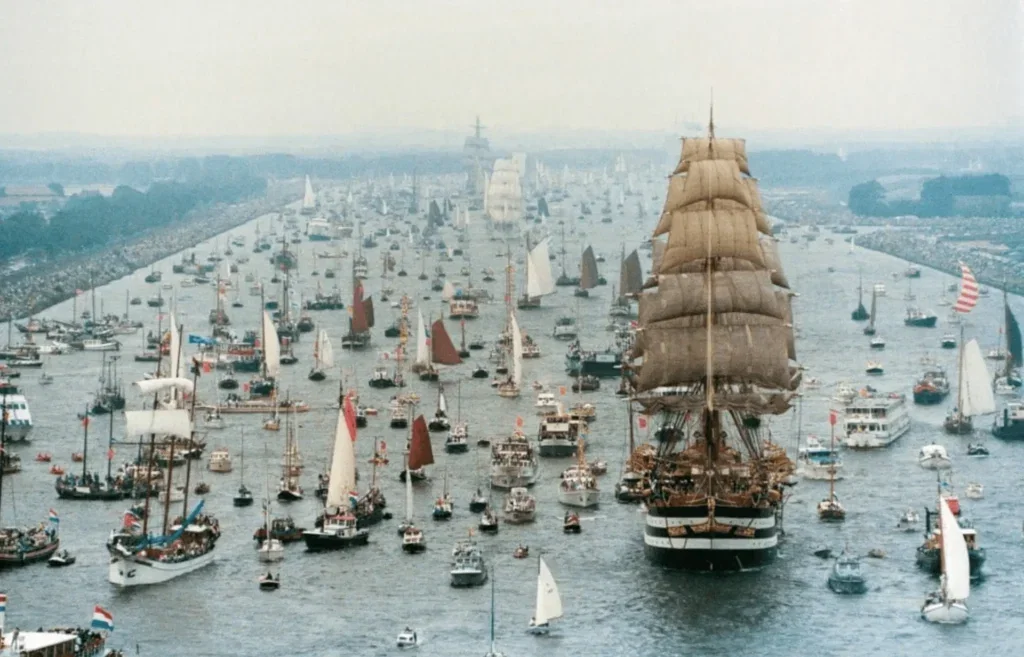
2.5 million visitors over five days in just a few square kilometers. SAIL Amsterdam is one of the largest events in the Netherlands. It’s an excellent venue for the Multi-modal Traffic and Transportation Learning Community (AIMTT) to collect data and develop and test AI models for real-time crowd management. An added bonus is the development of concrete AI tools and widely applicable learning modules.
Traditional traffic models struggle to predict human behavior. They do not take human caprices sufficiently into account, and there is too little data available on large one-day event peaks to make accurate predictions about crowd movements. AI models, on the other hand, have the potential to predict human behavior fairly accurately with relatively little data. To train these types of models, the AIMTT Learning Community was on-site during SAIL Amsterdam 2025.
We spoke with Sascha Hoogendoorn-Lanser, director of the Mobility Innovation Center at TU Delft and community lead for AIMTT, about this use case.
An AiNed Learning Community is a partnership between businesses, civil society organizations, and educational institutions. Through case-based learning, employees and students work on real-world cases, often from small and medium-sized enterprises (SMEs). Learning Communities are part of the AiNed program of the National Growth Fund and are coordinated by AIC4NL.
The Next Generation of Systems
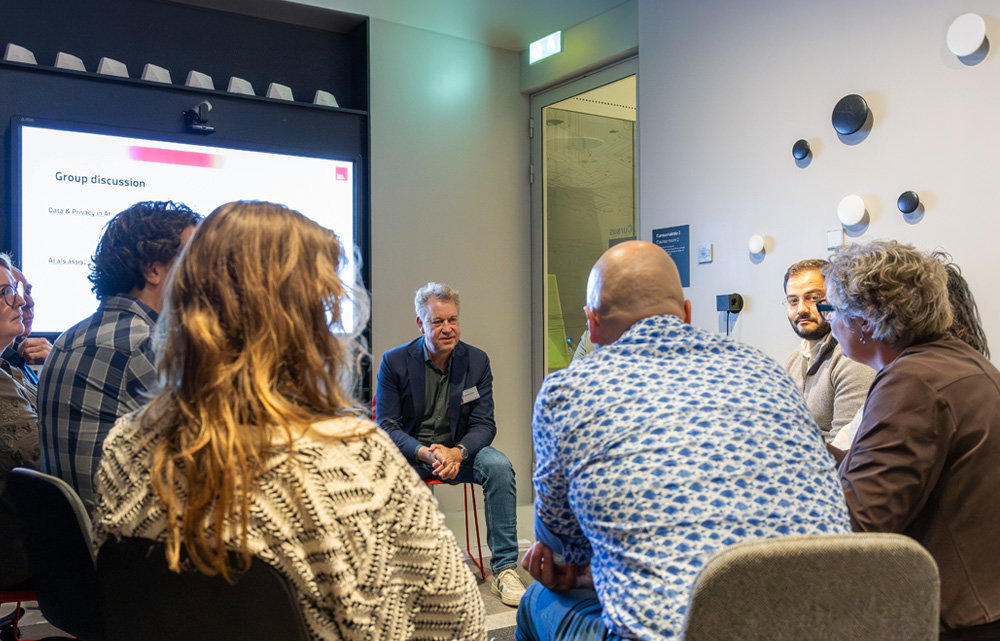
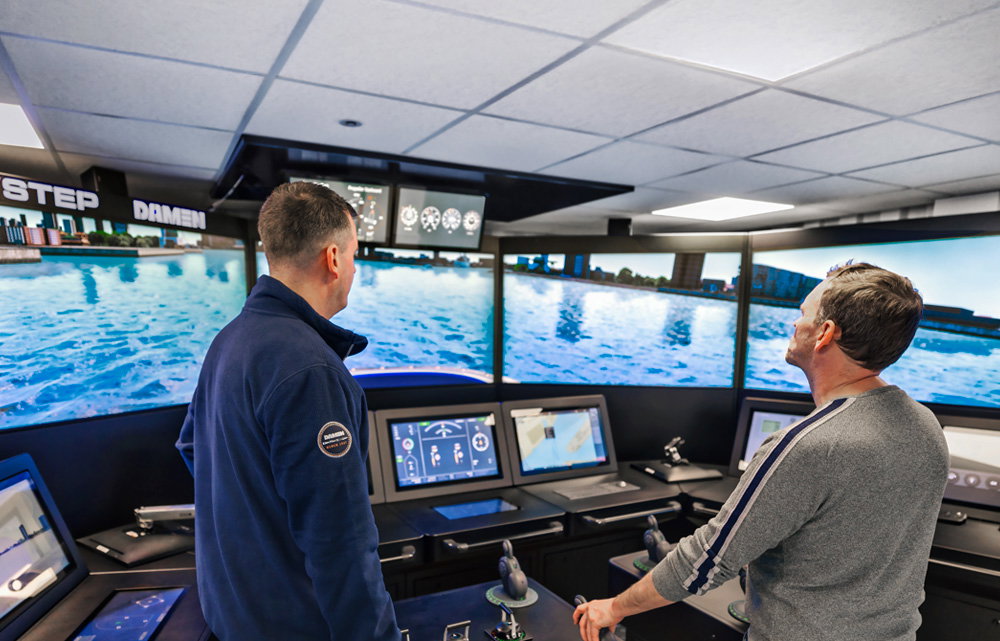
During SAIL Amsterdam, PhD students from TU Delft and SME representatives gathered in their own “boiler room,” where they could test their AI models live in a “digital twin” (a digital replica of the event area, fed with real-time data). Each group contributed specific expertise. “The TU Delft team included PhD students who are skilled at estimating and predicting situations. uCrowds excels at quickly simulating scenarios: if it’s that crowded over there, what can we expect over here? And Analyze provided the broader picture: what other traffic is heading toward the city. That collaboration worked very well,” Hoogendoorn-Lanser reflects.
The test environment was located right next to the event’s official control room, which housed the SAIL organization, the municipality, and the Amsterdam-Amstelland Safety Region. The digital twin piqued the curiosity of the control room staff. During the event, operators stopped by to see what the team had noticed and to discuss certain situations. For Hoogendoorn-Lanser, that’s exactly the point. “We want to work closely with the operators. Ultimately, these are the next-generation systems that will be running on those operators’ platforms.”
We now have these datasets, and we tell students: “Let’s see what you can come up with if you’re given eight weeks.” We then compare that with what the partners at SAIL have developed themselves. It’s a very educational experience.
Sascha Hoogendoorn-Lanser, community lead of the AIMTT Learning Community
Collecting Data Safely
SAIL served as the first test environment for the Amsterdam Events digital twin. It is a central platform where event schedules, sensor data, social media, and weather data are combined; AI models and visualizations are then used to assess the situation and, ultimately, make predictions. Following SAIL, the platform will be further developed for use at multiple events in Amsterdam.
AI requires data, and at events, that data comes from a wide variety of sources. During SAIL, data was drawn from occupancy rates of trains, subways, and buses, traffic congestion on highways, and parking lot occupancy. Camera footage was also used to track pedestrian flows, while ensuring privacy was maintained. The team did not view the footage. The AI immediately converts them into anonymous movement patterns. A Data Protection Impact Assessment was also conducted in advance of data use—an analysis of the privacy risks required by the GDPR for this type of data processing.
Using this data, the models were able to make real-time predictions about crowd levels and bottlenecks. The event was used as a training exercise; not all data was available, so the results weren’t perfect. “Unfortunately, we couldn’t monitor everything—ideally, you’d have the full picture. But we made significant progress. Assessing the current situation is the first step. Then we see if we can make predictions. There are even models already that can learn from what happened an hour ago, so they pick up on making predictions fairly quickly.”
Practical tools
The collaboration between small and medium-sized businesses and students resulted in three concrete tools. Analyze built an AI alert model that identifies bottlenecks in both pedestrian and vehicular traffic. uCrowds developed a simulation model for pedestrian flows. And TU Delft created a predictive model that estimates pedestrian traffic up to about four hours in advance. “Truly innovative solutions were developed here, simply because there was little available for events,” Hoogendoorn-Lanser reflects.
Because historical SAIL data was lacking, the latter became an adaptive hybrid model: it periodically refines itself during the event, corrects errors in real time, and provides a confidence interval with each prediction. This approach can be applied to other events without historical data, such as King’s Day.
According to Hoogendoorn-Lanser, this transfer to other events only works if domain knowledge of mobility and AI come together: “There are certain laws governing traffic that you have to take into account. A car doesn’t drive in reverse. These kinds of certainties, combined with factors that are difficult to predict—such as human behavior—make mobility issues like these a wonderful area of application for AI.”
Integration into Curricula
In the true spirit of a Learning Community, the lessons learned during SAIL are being shared. The AIMTT website features an accessible learning module consisting of nineteen videos covering the entire workflow of AI-driven crowd management—from data sharing and simulation to prediction, monitoring, and alerting—presented by experts from uCrowds, TU Delft, and Analyze.
The dataset has also become part of the course materials for two courses in TU Delft’s Master’s program in Transport, Infrastructure & Logistics. Thirty students are working with the data collected during SAIL. This is case-based learning in practice. “We now have these datasets and tell the students: ‘Show us what you can come up with if you’re given eight weeks.’ We then compare that with what the SAIL partners have developed themselves. It’s a very educational experience.”
Analyze, TU Delft, uCrowds, the City of Amsterdam, SAIL Amsterdam, and the Amsterdam-Amstelland Safety Region collaborated on this use case (duration: 2025–2026).