
With Breaking Barriers, the Eindhoven-based AI startup aims to establish a Trust Center, validate a European sovereign AI infrastructure, and expand internationally.
In the event of a missing person case or another large-scale police investigation, the police receive numerous tips. It is crucial that the investigative unit filter out the most important reports within the first 24 hours. And when a municipality investigates an applicant for a hospitality license for fraud, a civil servant must review dozens of documents before a conclusion can be reached. To ensure these types of processes are carried out carefully and accurately, large amounts of sensitive information must be processed. That requires a lot of manpower and time. AI speeds up this work, but the results must be traceable.
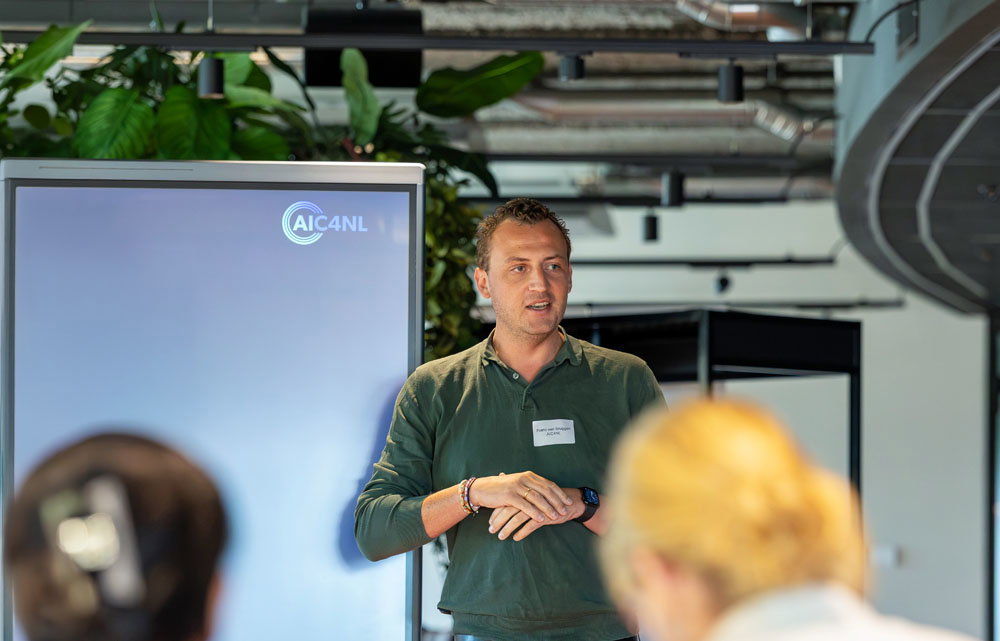
We spoke with co-founder Marijn van Aerle about Avendar's goals in the Breaking Barriers program.
First customer: the police
Van Aerle was the founder and, for ten years, the CTO of the lending company Floryn. Then he decided it was time for something different. In January 2025, he and two colleagues from Floryn started over from scratch. “We wondered how we could apply all the knowledge we’d built up in the financial sector to something with a significant social impact. That quickly led us to the government. That’s how we ended up in the security sector.” Shortly after the company was founded, the team participated in a startup challenge organized by the police and won it. It was a flying start.
Bearing the Burden of Proof
At the police department, Avendar uses the Integrity solution to categorize and prioritize incoming tips. In Bibob investigations (integrity screening for, say, a hospitality or coffee shop license), the software searches for signs of money laundering and other criminal activities. “Currently, employees spend hours clicking through all those documents. The investigative unit can only take on one out of every five cases because there aren’t enough people. We help investigators find red flags faster and free up capacity.”
The platform operates on two layers. At the bottom, AI models process a massive stream of unstructured data. Above that is a deterministic layer (fixed, verifiable rules) that makes the decisions. “An LLM is, by its very nature, difficult to trace. But before an ethics committee or in a court of law, you must be able to fully substantiate why you made a decision,” Van Aerle explains. The system therefore links a suspicious cash flow to the underlying agreement, financial statements, and bank statement. “We point it out. Here it is, in this document, and that document supports it. That’s how you build a trail that you can actually use in such sensitive processes.”
"We have growth goals, revenue targets, customers—all that sort of thing. But the most important milestone is expanding into Europe. That will be the most visible one, and I think it will also be the best."
Marijn van Aerle, co-founder of Avendar
Secure and Fair Software
For sensitive processes like these, major players such as OpenAI or Microsoft Azure are out of the question. The data is simply too sensitive. At the police department, the Avendar application runs in a secure environment that can operate without an internet connection (air-gapped). It uses various open-weights models and restricts the AI with guardrails (fixed safety rules). Avendar operates its own servers and handles not only the software but also the installation. To date, Avendar has built this entire AI chain primarily on its own.
So far, Avendar has primarily set up its secure AI environment on its own. Through Breaking Barriers, the startup is connecting with organizations that already provide sovereign and responsible infrastructure for the government. “There are other organizations working on this. It would be great if we could launch a broader initiative or partner with organizations that also work for the government.”
Anyone who supplies software to police departments and municipalities must demonstrate that it is secure, fair, and verifiable. Avendar ensures that the software complies with current standards. It conducts separate audits for work involving police data, tests everything for bias, and also assesses the impact on human rights. “You have to wade through the red tape, but your software also has to be built in such a way that you can operate in Europe.” This takes a lot of time, and to scale up more quickly, Avendar is setting up a Trust Center with the help of Breaking Barriers. This is a central location where government agencies can see which rules and standards the platform meets. “The Trust Center is an important milestone for us within Breaking Barriers. It allows us to demonstrate to the outside world that we meet all certifications and are trustworthy.”
Europe as the ultimate goal
According to Van Aerle, Breaking Barriers helps doors open faster. “You can build the connections you need to grow on your own, but that takes much longer. Breaking Barriers knows who excels at what and already has many connections with the government. That saves time. You immediately have the right people at the table.”
With Breaking Barriers, Avendar is looking explicitly beyond its borders. Fraud and money laundering are issues throughout Europe, and the rules for combating them are often the same across the continent. To achieve this international growth, Avendar must first validate a scalable, sovereign infrastructure—and Breaking Barriers helps with that. The ambition is to become a European, sovereign alternative to existing intelligence platforms.
About AiNed Breaking Barriers
Breaking Barriers helps Dutch AI startups accelerate their growth. The program opens doors to investors, mentors, companies, government agencies, and international markets. Breaking Barriers is part of the National Growth Fund’s AiNed program and is coordinated by AIC4NL.