In the third round of theAiNed ELSA Labs, a regulator is seated at the table for each use case. That’s a new development. RegGuides are being developed within the labs. These are concrete guidelines that help companies comply more quickly with theAI Actmore quickly, giving them more room for innovation. The proposals have now been submitted. The evaluation committee will select three of them.
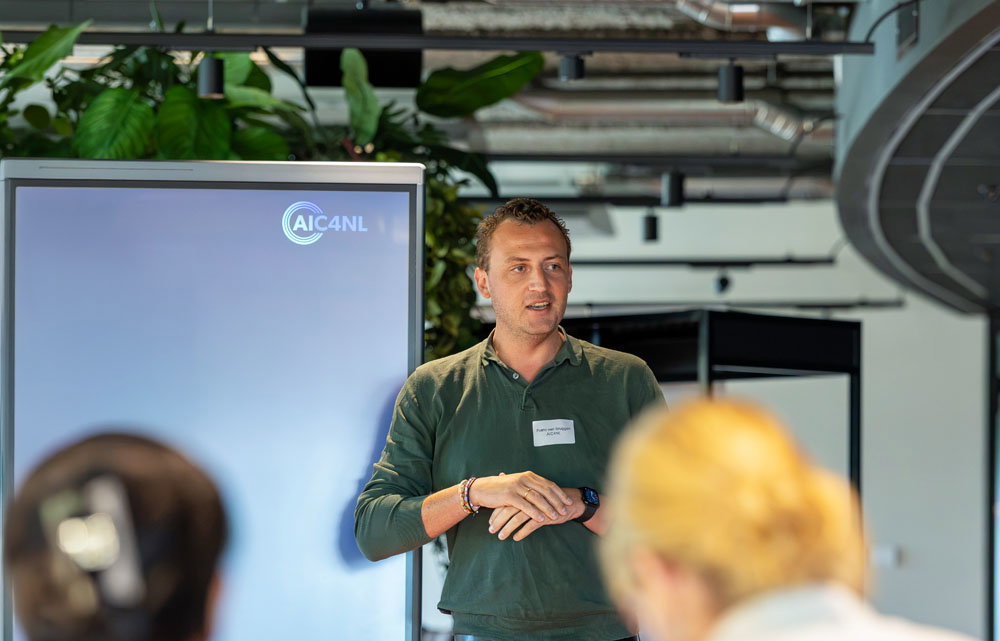
We spoke with Huub Janssen, chair of the evaluation committee. He explains why it is so important for the regulator to participate proactively.
The Netherlands' First AI Regulator
Janssen is an economist by training and has been working as a pioneer in this field since 2007. In 2020, the National Inspectorate for Digital Infrastructure (RDI) asked him to establish an AI oversight framework. “At that time, large language models (LLMs) were not yet known to the general public; no one knew what to expect from AI. Oversight had never been done before; there was no funding, and there were no staff. ‘Good luck,’ they said.”
Janssen first established AI oversight within the RDI, then launched the Dutch working group of AI regulators, and in 2022, a European counterpart. In 2025, together with the UN agency UNESCO, he launched a global network of regulators. On the ELSA Labs evaluation committee, he therefore primarily brings a regulatory perspective. Other members of the committee focus more on the business sector and AI technology.
If we ensure that companies become compliant quickly, we can get to market faster and compete more effectively. Because if you comply with the rules in Europe, you can enter any market.
Huub Janssen, founding member and chair of the ELSA Labs evaluation committee
RegGuides
The rules governing AI are set forth in the European AI Act. Even before the law has fully taken effect, it has already been amended through the Digital Omnibus, a European amending regulation. It’s no surprise, then, that companies are finding it difficult to be certain that their applications comply. The existing frameworks are often generic and abstract.
That is why the labs, in consultation with the regulator, are developing guidelines for compliance—known as RegGuides. According to Janssen, these guidelines will create concrete opportunities for the business community. “When it comes to frontier models (the largest AI models), Europe got a late start. But we haven’t lost the competitive race in the field of AI yet. Developing AI in a responsible manner is Europe’s strength. If we ensure that companies become compliant quickly, we can get to market faster and compete. Because if you comply with the rules in Europe, you’ll be accepted everywhere.”
Oversight also means helping to foster innovation
For each use case, the RDI’s AI Oversight Coordination Center and the Dutch Data Protection Authority (AP) assign a regulator from the relevant sector. The AI Act requires member states to take a proactive role by establishing a regulatory sandbox. This is a testing environment in which regulators and the business community work together to resolve compliance issues. According to Janssen, this is the way forward: “A regulator has a dual mandate. The societal responsibility to ensure that AI is safe, and the responsibility to proactively help companies comply with the rules so they can focus as much as possible on innovation. So it’s not just about checking after the fact and possibly imposing a fine, but about contributing ideas in advance.”
According to Janssen, the substance of the AI Act is more fundamental than is often thought. “It is, in essence, safety legislation. For example, it states that AI must not kill, must not injure anyone, and must not discriminate. This concerns fundamental rights that must not be undermined, and applications that must not be hacked. These are actually very logical safety issues.”
Most companies want that too, but it often takes time and effort. The more a company focuses on security, the less energy it sometimes has left for innovation. That’s why this regulation is so important, says Janssen. “We can focus fully on innovation if we make it easy for companies to comply with the law.”
And when it comes to innovation, speed is crucial. Because AI is developing so rapidly, Janssen wants to see a fast turnaround for use cases within the labs. “That can be done using an agile approach (in small steps)—don’t wait until something is completely finished, but provide an update every three months. That way, you show what you’re doing, you can easily make adjustments, and you help companies achieve compliance as quickly as possible. Anything that takes longer than half a year is often already outdated.”
Think Big
Europe’s opportunity lies in developing AI in a responsible manner. According to Janssen, this market will grow rapidly over the next three to five years, both in Europe and worldwide. To capitalize on this, Europe needs to think bigger, Janssen says. “I’d like to see us tackle this on a large scale. If we want to make a difference, we need companies that are serious about scaling up—not just in Europe, but around the world.”
That is also in the interest of the regulators. Because, just like consumers and businesses, regulators also need an alternative. “If we are dependent on just a few suppliers from outside the European Union, it becomes nearly impossible for regulators to intervene. The most extreme measure is to remove a player from the market, but that’s not possible if there is no European alternative.”
In an AiNed ELSA Lab, scientists, companies, governments, and citizens work together to explore how to develop and apply AI responsibly. ELSA stands for Ethical, Legal, and Societal Aspects. Each lab evaluates AI applications against ethical and legal standards within a specific field of application, such as healthcare, energy, mobility, or the engineering industry.
Starting November 17, 2026, small and medium-sized businesses can apply for the FARM360TECH call for proposals. Up to €60,000 is available per company, plus...
Things are going great, things are going well—actually, they’re getting better and better. And then, all of a sudden, they’re not anymore. With the disease...
In an AiNed ELSA Lab, scientists, companies, government agencies, and citizens work together to explore how to develop and apply AI responsibly. ELSA stands for Ethical, Legal, and Societal Aspects. Each lab evaluates
AI is rapidly evolving from a specific digital technology into a systems technology that is transforming the economy, government, and society. This offers opportunities for productivity and innovation, but also raises questions
To provide the best experience, we use technologies such as cookies to store and/or access device information. Giving consent to these technologies allows us to process data such as browsing habits or unique IDs on this site. Not giving consent or withdrawing consent may adversely affect certain features and capabilities.
Functional
Always active
The technical storage or access is strictly necessary for the legitimate purpose of enabling the use of a specific service explicitly requested by the subscriber or user, or for the sole purpose of carrying out the transmission of a communication over an electronic communications network.
Preferences
The technical storage or access is necessary for the legitimate purpose of storing preferences that are not requested by the subscriber or user.
Statistics
The technical storage or access that is used exclusively for statistical purposes.The technical storage or access that is used exclusively for anonymous statistical purposes. Without a subpoena, voluntary compliance on the part of your Internet Service Provider, or additional records from a third party, information stored or retrieved for this purpose alone cannot usually be used to identify you.
Marketing
The technical storage or access is required to create user profiles to send advertising, or to track the user on a website or across several websites for similar marketing purposes.