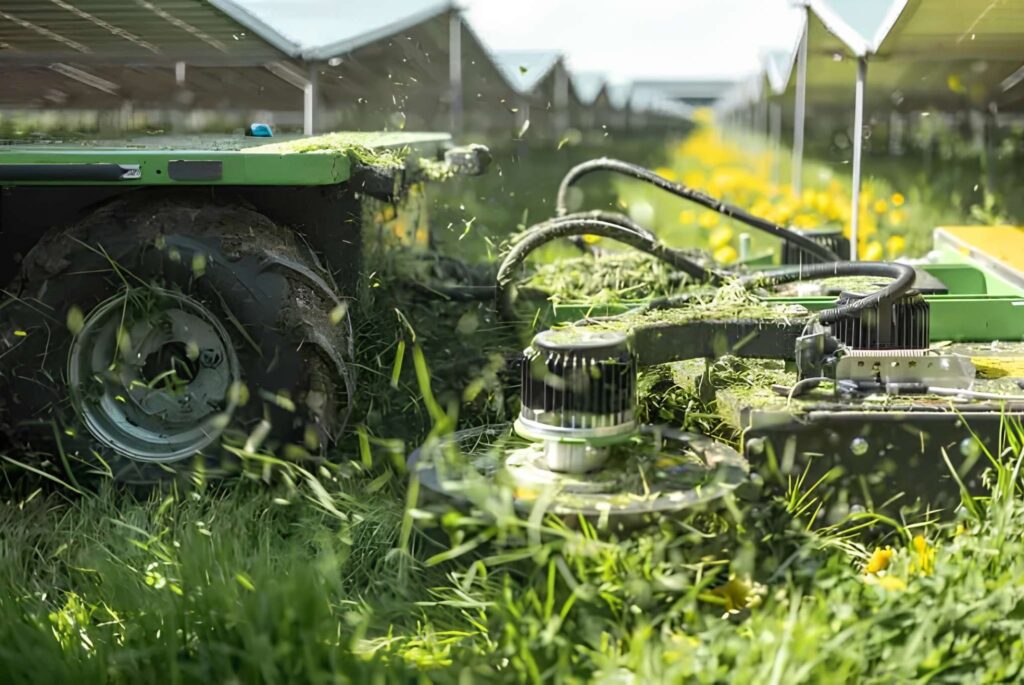
Agricultural mowing robots often rely on satellite navigation. But in solar farms, the panels block the signal, making manual mowing necessary—a time-consuming process. To prevent this, Vector Machines is developing autonomous, AI-driven mowers. With Breaking Barriers, the Frisian startup aims to expand this innovative solution with a dual-function capability.
We spoke with co-founder Sander Steegstra about the technology behind the robot and their goals within the program.
Breaking Barriers helps promising AI startups overcome barriers that stand in the way of their further growth. Breaking Barriers is part of the @National Growth Fund’s AiNed program and is coordinated by AIC4NL.
Autonomous Driving
“We solve the problem of the lack of a GPS signal by using sensor fusion technology and AI algorithms,” Sander explains. “We determine the robot’s exact position by, among other things, combining the wheel’s revolutions with data from various sensors. A fold-out obstacle mower then effortlessly mows the grass around the thousands of posts in a solar park.”
At the start of the process, a digital map of the solar farm is loaded into the robot. In practice, however, the posts are not always located exactly where indicated. The robot therefore records the actual locations of the posts as it moves along its route and automatically updates the map, ensuring that it never bumps into the same post twice.
Mowing and inspecting at the same time
Vector Machines plans to use the Breaking Barriers program, among other things, to develop a second innovative application: a thermal inspection tool. Normally, solar farms are inspected only once a year from above using a drone to detect heat leaks, short circuits, and broken glass. Vector wants to conduct these inspections continuously and from below, at the same time as mowing the grass.
For this new feature, the robot captures overlapping images using a thermal camera. An AI model is currently being trained to autonomously detect malfunctions and broken glass in these images. “If you inspect with a drone and a problem arises tomorrow, you won’t know about it until next year at the earliest,” explains Steegstra. Because the robot mows and inspects continuously, malfunctions can be detected and resolved much more quickly. Sander estimates that, partly because of this, the payback period for a mowing robot can be achieved within two years.
Robot-as-a-Service
In addition to further developing the inspection tool, Vector is working with Breaking Barriers to find ways to simplify the current technology so that end users can use it more easily. It also wants to make progress in how it approaches the market. “Should we move toward a ‘robot-as-a-service’ model, or simply sell the robots? We’ll be validating that business model in the coming months.”